Get Full Government Meeting Transcripts, Videos, & Alerts Forever!
Get email alerts on the Legal Settlement topic
No spam. Unsubscribe anytime.
Board of Estimates approves $11 million settlement in vacated 1992 murder conviction case
Summary
The Baltimore City Board of Estimates approved an $11,000,000 settlement to resolve a 2024 lawsuit by Anthony Hall after a court granted a writ of actual innocence; the payment will be split with $6,000,000 paid immediately and the remainder in 2027.
The Baltimore City Board of Estimates on Aug. 5 approved an $11,000,000 settlement to resolve a 2024 lawsuit filed by Anthony Hall after his 1992 conviction for the murder of Gerard Dorsey was vacated through a writ of actual innocence.
Deputy Solicitor Stephen Salisbury told the board the case turned on two trial eyewitnesses who later recanted their testimony. Salisbury said Hall had been convicted in April 1992, served about 25 years on parole and later obtained a writ of actual innocence; he also pursued state compensation under the Walter Lomax Act and was awarded $2,360,000 in administrative proceedings. The law department recommended settling to avoid protracted litigation and the risk associated with further trial, Salisbury said. "We're recommending the settlement amount of $11,000,000," Salisbury said, adding the city will pay $6,000,000 immediately after Board approval and the balance in 2027.
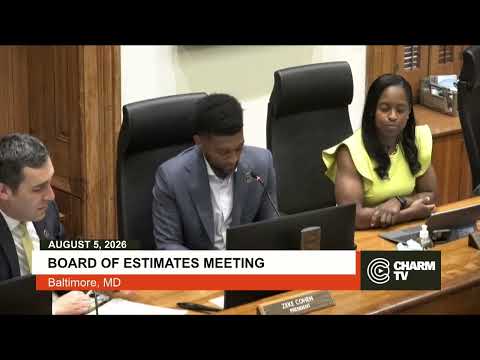
Council President Zeke Cohen (introduced earlier in the meeting) acknowledged the sum is large but said it does not compare to the 25 years the plaintiff lost. "$11,000,000 is an enormous amount of money, but it is nothing compared to the 25 years that this man lost in his life," the council president said. Mayor Brandon M. Scott also framed the payment as evidence of why the city has reformed policing: "Lives were ruined," he said, arguing the city must avoid coercive practices that produced wrongful convictions.
The board moved and seconded the motion to approve the settlement and voted in favor; the law department's presentation and the board's questions preceded the vote. The settlement was described as a full resolution of the city's liability in the 2024 suit arising from events tied to the vacated 1992 conviction.
What happens next: Salisbury said the law department will arrange for the installments as outlined; the board's approval authorizes payment per the settlement terms.