Get Full Government Meeting Transcripts, Videos, & Alerts Forever!
Get email alerts on the General Fund topic
No spam. Unsubscribe anytime.
Midyear finance briefing: Dayton revenues modestly above budget as income tax flattens
Summary
City finance staff told commissioners midyear revenues are modestly above budget led by new cannabis and photo-enforcement receipts, while income-tax collections are essentially flat and personnel and utility costs are rising.
Abby, the finance presenter, told the commission that total general-fund revenues at midyear were roughly $1.0 million above the same point last year — about 0.8% — and that overall midyear collections were performing within a normal historical range.
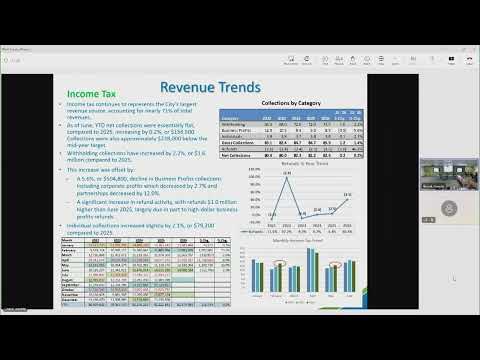
"Total revenue is 50.6% of the budget compared to the historical average of 49.6," Abby said, adding that seven of the city’s 10 revenue categories were performing above budget. She warned that income tax, the largest revenue source, had been essentially flat year to date and that refunds — particularly large business-profit refunds — had reduced net collections.
Staff highlighted several revenue drivers: a stronger local government fund after a prior-year settlement, new adult-use cannabis tax deposits beginning in 2026, and increased fines and forfeits after traffic-enforcement camera receipts were moved into the general fund. On the expenditure side, Abby said personnel costs were up about $5.4 million year over year but remained under the approved budget; contracts and materials were also higher, driven by rising utility payments and timing of regional-dispatch payments.
The presenters said the revised revenue forecast under preparation is expected to be above the original forecast largely because of the cannabis distribution and a potential unplanned VWC refund, but cautioned that slower economic growth and international uncertainty remain risks. Staff projected a balanced year-end budget, with an anticipated draw of about $5–6 million of one-time sources instead of the $10.6 million originally planned.
Commissioners asked for follow-up on sector-level job-growth drivers and staff agreed to provide a deeper breakdown of which industries were adding positions.