Get Full Government Meeting Transcripts, Videos, & Alerts Forever!
Get email alerts on the 2904 Winstead Road topic
No spam. Unsubscribe anytime.
Torrington commission continues public hearing on 2904 Winstead Road amid debate over excavation vs. planting mitigation
Summary
The Torrington Wetlands Commission continued the public hearing for 2904 Winstead Road to Sept. 8 after the project team and commissioners debated whether to create wetland storage through excavation or to pursue a lower‑disturbance planting buffer; the team will revise maps and planting/mitigation plans.
The Torrington Wetlands Commission on Aug. 4 continued a public hearing for an application affecting 2904 Winstead Road to allow the project team to submit revised maps, planting plans and mitigation calculations.
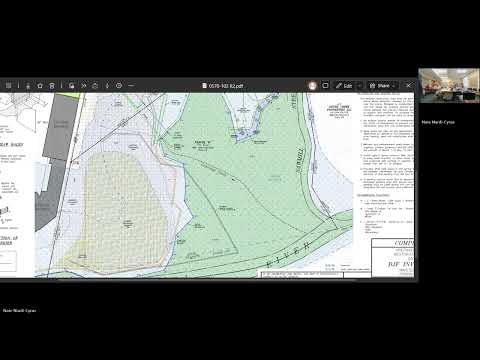
Martin Potter, the consulting planner for the project, told the commission the team submitted a revised map and had fielded recommendations from the town’s soil scientist. "We've got we've submitted that for the record," Potter said, introducing the team and naming a soil scientist and surveyor who would explain changes. The application record lists the applicant as "Martin Connor," while Potter identified himself as the consultant speaking for the proposal.
The central dispute at the hearing was how to achieve required mitigation. The project's soil scientist (appearing in the record as Ian — the spelling varies in meeting materials) described deep sandy deposits and said that "if you have more than 2 feet of fill on top of naturally occurring soils, it's no longer technically a wetland," a technical point that shaped options. The team outlined two principal approaches: (1) excavating a basin to intercept groundwater and create compensatory wetland storage — a construction‑intensive option that would remove trees and require earthworks — or (2) a lower‑disturbance approach planting a dense riparian buffer and avoiding significant grading.
Commissioners and the project team discussed plant stock and survivability. The team recommended larger, more vigorous stock — "3 to 4 foot tall shrubs" or larger container sizes — rather than many small plugs, arguing higher initial vigor would increase survival and make monitoring meaningful. The commission also raised common construction controls such as anti‑tracking measures at a timber bridge approach and standard erosion and sediment controls during demolition and site work.
After extended discussion about restoration area size and how to calculate mitigation, a commissioner moved to continue the public hearing to Sept. 8 so the project team could return with clarified maps, grades and a planting/mitigation proposal; the motion passed unanimously. The commission indicated it would consider conditioning any approval on a timeline for implementation, with several members noting spring 2027 as a reasonable target for plantings if the project proceeds.
The commission is scheduled to take up the revised submission at its Sept. 8 meeting.