Get Full Government Meeting Transcripts, Videos, & Alerts Forever!
Get email alerts on the Export Controls topic
No spam. Unsubscribe anytime.
Chairman highlights $2.5B DOJ chip-smuggling indictment and urges tighter export controls
Summary
At a House select committee hearing, lawmakers and witnesses described alleged smuggling of U.S. AI chips to China, cited a DOJ $2.5 billion case and urged stronger export controls, licensing limits and cloud KYC rules to keep advanced compute out of adversary hands.
Chairman Mullinar opened the hearing by calling China's acquisition of advanced U.S. AI chips a "very important topic," and cited a recent Department of Justice announcement of a "$2,500,000,000 chip smuggling case," which he said would be the largest export-control violation in U.S. history.
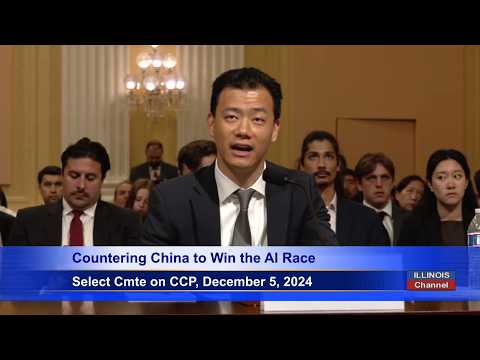
Dimitri Alperovich, introduced as cofounder and chairman of the Silverado Policy Accelerator and former CTO of CrowdStrike, told the committee that "compute is the binding constraint in this competition" and urged Congress to "hold the line on export controls and close loopholes." He recommended no licenses for advanced AI chips to China and backed legislation such as the AI Overwatch Act that would require mandatory congressional notification for exports and verifiable safeguards against military end use.
Alperovich described recent DOJ indictments involving billions of dollars in illicitly exported NVIDIA chips and recounted allegations involving Supermicro cofounder Wally Liu, saying alleged smugglers removed serial-number labels and used fake server boxes to conceal shipments. "There should be no licenses granted for advanced AI chips to China period," he said.
The witnesses and members framed export controls as a near-term choke point that must be reinforced with complementary policies—ranging from restrictions on semiconductor manufacturing equipment to cloud-provider rules to prevent training of foreign models on U.S. infrastructure. The hearing ended with the chair allowing members to submit documents for the record before adjourning.
The committee did not vote on legislation during the session; senators or other members may pursue bills that reflect the witnesses' recommendations.