Get email alerts on the Textbook Adoption topic
No spam. Unsubscribe anytime.
Board approves K–12 math materials; Kiddom (K–5) and Mathspace (6–12) adopted
Summary
The Franklin City School Board approved Kiddom for K–5 on a seven‑year adoption and Mathspace for grades 6–12 on a three‑year adoption after a staff presentation on state-required adoption processes, costs and training plans.
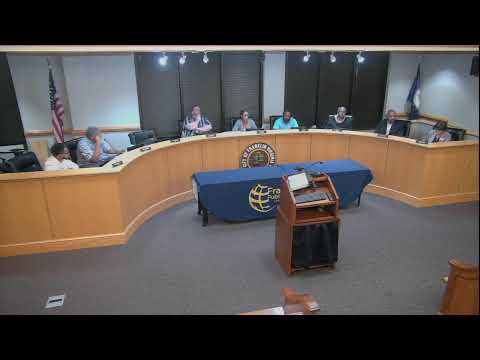
The Franklin City School Board voted to adopt new K–12 mathematics instructional materials, approving a seven‑year adoption for Kiddom (K–5) and a three‑year adoption for Mathspace (6–12).
A staff presenter summarized the textbook-adoption process required by state code and local board policy and described stakeholder review, vendor options and costs. "I am asking that the board approve per the superintendent's recommendation, a 7 year approval for Kiddom and the 3 year approval for Mathspace," the presenter said. The presentation listed a seven‑year cost for Kiddom of $75,044.14 and offered shorter‑term license pricing when seven‑year licensing was unavailable for some vendors.
Board members asked detailed implementation questions about the digital components of Kiddom, including screen time and classroom use. The Vice Chair asked, "What specific daily screen time limits and administrative guidelines will central office enforce to ensure our K through 5 teachers are leading face‑to‑face instruction rather than having young students learn passively from digital modules?" Staff replied that physical student books were available for younger grades, teachers would receive training that addresses both platform navigation and instructional use, and the division will use diagnostic and benchmark assessments to measure effectiveness.
Following discussion, a board member moved to approve the recommendation; the motion was seconded and the board voted in favor. The presenter said adopting longer license terms typically reduces long‑term costs and supports continuity and training for teachers.
AI generated
The text on this page is AI generated. Summaries, highlights, analysis, and video transcripts are all produced from the original source material.
AI can make mistakes, so if you spot one, and we will fix it for everyone.
Note: the source content is unaltered by us. Any content source we link to, be it a video, an audio recording, or a document, is presented exactly as its publisher released it. That publisher is usually a government body, sometimes an individual official or another organisation.