Get Full Government Meeting Transcripts, Videos, & Alerts Forever!
Get email alerts on the Fiscal Capacity topic
No spam. Unsubscribe anytime.
Committee drafting comprehensive plan highlights strong capital improvement plan and refines fiscal-capacity language
Summary
Committee members praised the town's well-funded capital improvement plan and discussed how the fiscal-capacity section should reflect current practices, clarify responsibilities, and avoid language that could be read as prioritizing short-term patchwork over timely maintenance.
At a meeting of the committee drafting the town's comprehensive plan, members reviewed the draft fiscal-capacity chapter and contrasted the town's capital improvement plan (CIP) with common practice in similar communities.
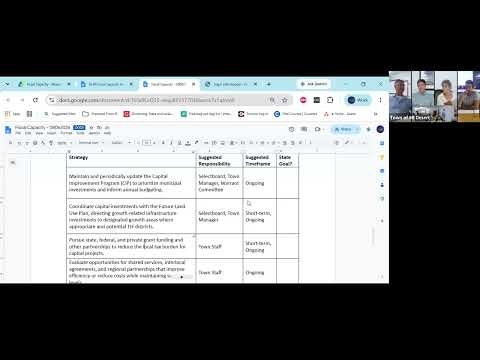
A staff member said the town "happen[s] to have a actually adequately funded CIP plan" and described the CIP as a systematic program for budgeting big-ticket items such as plow trucks, wastewater infrastructure and fire equipment. The staff member used a plow truck as an example of how the CIP sets aside money over time so replacements do not require emergency tax increases.
The committee agreed the fiscal-capacity section should reflect the town's existing practices rather than invent new machinery. The draft goal proposed in the chapter is to "plan, finance and prioritize municipal investments to maintain public facilities and services while supporting the town's long-term goals." Members asked that short-term language be adjusted so it does not imply the town should favor temporary repairs over appropriate replacement.
Committee members also discussed who would carry out recommended tasks. The working assumption is town staff (public works and other departments) will prepare grant proposals and manage projects, with review and approval flowing to the warrant committee and the select board as appropriate. The committee requested clearer responsibility assignments in the chapter so readers know which offices should take action on grant applications, routine maintenance and capital projects.
The draft will be refined to (1) tighten the objectives and strategies, (2) add a brief explanation of how the CIP operates, and (3) clarify suggested responsibility flows to town staff, the warrant committee and the select board before the section is posted for public review.