Get Full Government Meeting Transcripts, Videos, & Alerts Forever!
Get email alerts on the Public Safety topic
No spam. Unsubscribe anytime.
Nash County approves swift-water rescue team, grant-backed DWI deputy and new records position
Summary
After discussion about regional duplication and sole-source procurement, commissioners approved the sheriff's request to form a Type 3 swift-water rescue team, accept a 4-year DWI enforcement grant that funds one deputy (year 1 cost $163,007.48), and convert part-time funds to a full-time records assistant position.
The Nash County Board of Commissioners approved multiple sheriff's office requests at its Aug. 3 meeting, including creation of a Type 3 swift-water rescue team and a grant-funded driving-while-impaired (DWI) deputy position the sheriff's office says will initially cost $163,007.48 in year one, covering salary and a vehicle.
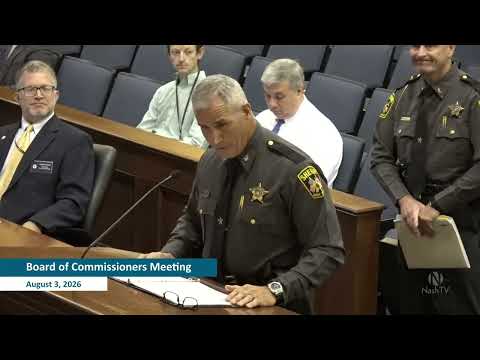
Lieutenant Tony Cameron, who the sheriff assigned to organize the team, described the unit's purpose and training needs and said it would respond to flood rescues locally and regionally. "This swift water rescue team will be a type 3 team capable of rescuing folks that are stranded in our homes from floodwaters," he said, citing past fatal flooding events in the county. Commissioners questioned whether the county should start a duplicate team when neighboring Rocky Mount already has a ranked rescue team; one commissioner said the county should instead consider partnering with that city. County and sheriff's office staff said the start-up package and equipment are state-funded, and the board approved the sole-source purchase and team formation.
The board also accepted a four-year governor's highway safety grant to fund one DWI task-force deputy with a phased county match. "What they applied for in the grant and what's been approved is $163,007.48," the sheriff's representative said, adding that equipment and vehicle are included in that figure for year one and that subsequent years would carry only salary and benefits with an increasing county share. Commissioners discussed projected county obligations in years 2—0 and the requirement to reapply each January; the board voted to participate.
Finally, the sheriff's office asked to convert existing part-time funds into a full-time records/office assistant position to handle increased processing workloads (concealed-carry permits, Odyssey case work). Staff estimated the net additional annual cost would be modest and the board approved the hiring plan and associated budget adjustments.