Get Full Government Meeting Transcripts, Videos, & Alerts Forever!
Get email alerts on the Energy Projects topic
No spam. Unsubscribe anytime.
Council rejects $9.2M energy-savings contract after questions about costs and guarantees
Summary
Bakersfield council declined to approve a proposed $9.2 million energy-savings performance contract with Willdan Energy Solutions after members and public commenters raised concerns about worst-case costs, contingency, and ratepayer risk.
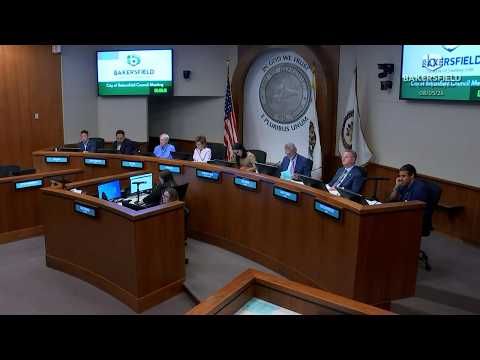
The Bakersfield City Council voted 4–3 on Aug. 5 to reject staff’s recommendation to approve a proposed energy-savings performance contract with Willdan Energy Solutions that would have installed solar canopies, a Tesla battery and EV infrastructure at the Water Resources Administrative Office.
Assistant Water Director Daniel Maldonado told the council the project would generate about 734,000 kilowatt-hours per year and aimed for a roughly $414,000 annual utility savings, with a net capital cost to the water enterprise fund of about $5.5 million under the worst-case assumptions. “For the amount of infrastructure located at this facility, the electrical costs are, on average, $700,000 to $800,000 annually,” Maldonado said, adding the projected savings would be reallocated within the water department.
Opponents at the dais and during public comment pushed back on key assumptions. Public speaker Terry Maxwell urged caution, saying long-term equipment degradation, previous municipal change orders and uncertain grant incentives could erode expected savings: “When you are considering this ... how much are you gonna make in return, I think you, you know, don't make the mistake all governments do,” Maxwell said. Councilmember Coleman described the payback window — 13 years in staff’s best case, up to 18 in the staff’s worst case — as problematic for equipment with a similar lifespan and moved to not approve the item.
Staff and the Willdan consultant said the contract is a GMAX (not-to-exceed) delivery model that includes contingency and warranties; consultant Scott Strom said degradation and replacement costs were built into the project’s 25-year financial model and that the battery carries a 20-year warranty. Still, several council members said the city cannot assume grant and tax-credit outcomes. Councilmember Coleman’s motion not to approve carried on a roll call that left four members in favor of the motion and three opposed, effectively denying the energy contract that night.
City staff said the water enterprise fund would have paid for the work and that project documents and an investment-grade audit remain available for future consideration. The council’s decision leaves the proposed work on hold pending any future reintroduction.