Get Full Government Meeting Transcripts, Videos, & Alerts Forever!
Get email alerts on the Calrht Overview topic
No spam. Unsubscribe anytime.
State officials outline CalRHT’s rural care model and goals for EHR grants
Summary
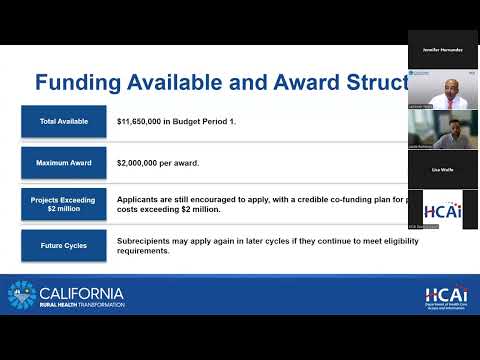
HCAI leaders described the California Rural Health Transformation (CalRHT) program’s transformative care model — combining workforce initiatives and technology — as the basis for year‑one EHR modernization grants focused on building foundational EHR capacity in rural providers.
Jennifer Hernandez, director of the California Rural Health Transformation program at the Department of Health Care Access and Information (HCAI), opened the session and said the new grants are intended to help rural health providers adopt or modernize electronic health records.
"As you know, today's session is primarily focused specifically on EHR modernization grants," Hernandez said, describing the award as one of the first funding opportunities launching under CalRHT. She urged "early and sustained participation" across multiple budget years so organizations can position themselves for future opportunities.
Dr. Lemenya Tafara, HCAI’s chief medical officer and deputy director for innovation, said the CalRHT initiative is built on a "transformative care model" that leverages workforce and technology to develop person‑centered care across rural California. "The aim of the transformative, care model is to is to develop person centered care," Tafara said, listing priorities such as maternal and primary care collaboratives, workforce recruitment and retention, and tools to bridge gaps in low‑resource communities.
The presenters framed EHR modernization as a foundational step to enable further investments — like telehealth, interoperability and cybersecurity — that the program may fund in later budget periods if additional resources are allocated.