Get Full Government Meeting Transcripts, Videos, & Alerts Forever!
Get email alerts on the Public Nuisance Parking topic
No spam. Unsubscribe anytime.
South Bend council tightens vehicle, parking and nuisance rules to close enforcement gaps
Summary
The Common Council adopted four related ordinances updating nuisance definitions, abandoned-vehicle rules, improper-parking provisions and large-vehicle regulation to improve enforcement and align city code with Indiana law. Staff said changes clarify when vehicles and debris may be deemed public nuisances; residents urged stronger enforcement and equity safeguards.
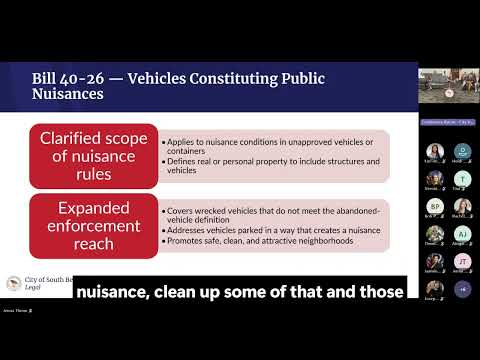
The South Bend Common Council on July 27 adopted a package of four ordinances intended to close enforcement gaps for vehicle- and parking-related nuisances and align the municipal code with state law. City attorney Jenna Froe told the Committee of the Whole the changes clarify that debris in containers or in vehicles can constitute a public nuisance and add definitions for wrecked or nuisance vehicles to allow enforcement in situations that do not meet the state law’s narrow "inoperable" standard.
Froe said the city kept a three-day rule for vehicles left in the right of way — noting that a state law 24-hour standard is not practical in dense urban neighborhoods — and aligned the large-vehicle definition with the zoning ordinance so staff can measure physical size rather than gross weight. "We wanted objective definitions that staff can apply in the field," she said during the presentation. Liz Meredith, chief neighborhoods officer, told council members the Department of Community Investment believes the updates will strengthen existing enforcement practices rather than immediately require new hires, but asked the council to review staffing needs during the upcoming budget process.
At public comment, longtime resident and former council member Derek David Dieter urged more vigorous enforcement and monthly reporting on complaints and tows; other speakers warned about possible discriminatory application against low-income residents unless the city pairs enforcement with outreach. "These rules are a good premise as long as there is a functioning enforcement process," Dieter said. Council members pressed staff for a six- or 12-month implementation check-in. On third reading the council recorded roll-call votes and adopted the four ordinances.