Get Full Government Meeting Transcripts, Videos, & Alerts Forever!
Get email alerts on the Vehicle Ordinances topic
No spam. Unsubscribe anytime.
Committee advances four linked vehicle/parking ordinances to committee of the whole
Summary
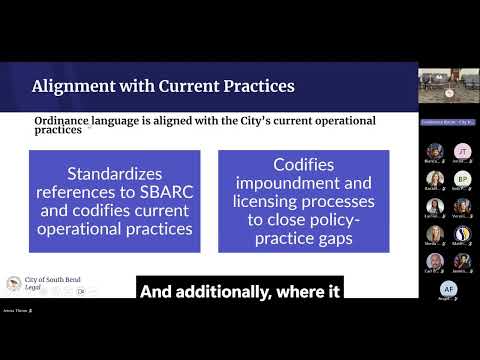
Staff presented four companion bills to close vehicle‑related enforcement gaps: clarifying public-nuisance definitions, adding a 'wrecked vehicle' category, aligning abandoned-vehicle removal rules with Indiana law (with a 3-day street carve-out), broadening improper-parking prohibitions and adopting the zoning code's large-vehicle definition. Committee sent each bill with a favorable recommendation.
Assistant City Attorney Jenna Thoreau told the Residential Neighborhoods Committee that four interrelated bills aim to close enforcement gaps and make vehicle-related nuisance rules easier to apply in neighborhoods. The package would clarify public-nuisance scope, add a defined "wrecked vehicle" category for enforcement where inoperability is clear, and create a totality-of-circumstances nuisance test for vehicles that do not meet the wrecked or abandoned definitions.
Thoreau said the abandoned-vehicle article was updated to incorporate changes in Indiana law but retained practical local adjustments: in urban street settings the city will continue to require three days of nonmovement before treating a street-parked vehicle as abandoned, while the 24-hour state standard would apply to vehicles left on city-owned public property.
The improper-parking bill broadens the ordinance to protect sidewalks, alleys, tree lawns and rights-of-way and includes a progressive penalty structure for repeat violations. The "large vehicle" bill adopts the zoning ordinance's physical-size–based definition (instead of a gross-vehicle-weight standard) to make on‑the‑street enforcement easier.
Committee members asked primarily about enforcement capacity; staff and neighborhood-services representatives said existing field inspectors will continue to respond to complaints and to follow up on observed violations as resources allow. After the presentation, the committee moved each bill to the committee of the whole with a favorable recommendation; roll-call votes were recorded and announced as unanimous on the record.
No public speakers opposed the bills during the hearing portion of this meeting. The bills were forwarded to the committee of the whole for further consideration and potential adoption.