Get Full Government Meeting Transcripts, Videos, & Alerts Forever!
Get email alerts on the Monitoring And Evaluation topic
No spam. Unsubscribe anytime.
Audit finds program outcomes hard to measure; debate over modeling vs. monitoring
Summary
The audit found that MDA's reported pollution-reduction numbers are estimates based on models and that the program lacks reliable monitoring to show actual water-quality impacts; MDA defended calibrated models and cited limited field monitoring.
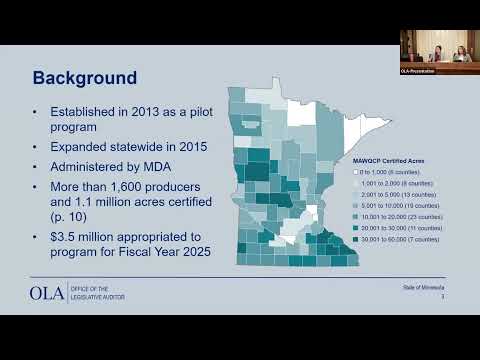
The Office of the Legislative Auditor told the Legislative Audit Commission that the Agricultural Water Quality Certification Program does not currently collect data that can demonstrate its actual impact on Minnesota’s waters.
"The program's effect on water quality is not clear," Caitlin Zenoni Wells said, noting that MDA’s estimates capture projected impacts from conservation practices rather than measured changes in water chemistry. OLA found certifiers do not always record accurate implementation dates or all practices that were installed, which weakens modeled estimates.
Commissioners pressed whether more monitoring should be incorporated. MDA Commissioner Tom Peterson acknowledged monitoring limits but defended the agency’s use of scientifically calibrated models: "Well pre calibrated models ... can predict the average pollution reduction estimate generated from those proven practices on thousands of simulations instantly," he said, while also noting that edge-of-field monitoring is expensive and can take years to show parcel-level outcomes.
OLA recommended the Legislature clarify program purposes and consider incorporating water-quality monitoring for a selection of certified producers to better demonstrate outcomes. Peterson said MDA is drafting a monitoring proposal and that the agency already runs edge-of-field monitoring on a limited set of farms to support model calibration.