Get Full Government Meeting Transcripts, Videos, & Alerts Forever!
Get email alerts on the Agriculture Water Quality topic
No spam. Unsubscribe anytime.
Audit: Minnesota often certifies farms before required conservation practices are in place
Summary
An Office of the Legislative Auditor review found that Minnesota’s Agricultural Water Quality Certification Program frequently issues certifications contingent on future actions, raising concerns that department practice does not align with statute and recommending legislative clarification and policy changes.
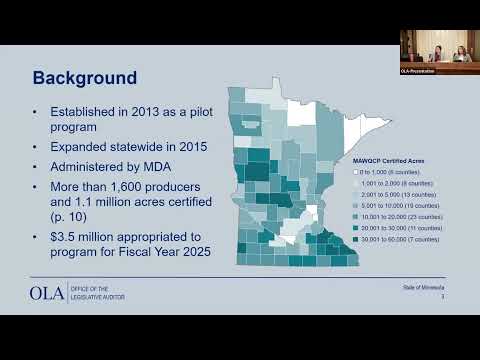
An audit presented to the Legislative Audit Commission found that the Minnesota Department of Agriculture (MDA) often certifies agricultural producers before they have implemented the conservation practices required by statute.
"We found that certifiers regularly certified producers to whom they have provided technical assistance despite this law, but the prohibition in law may not be practical," Caitlin Zenoni Wells, evaluations manager for the Office of the Legislative Auditor (OLA), told commissioners. OLA reviewed certification records and site visits and concluded that many certifiers advise producers during assessments in ways that could constitute the prohibited "technical assistance." The report said the statutory definition of certification — for producers who "demonstrate" practices sufficient to protect water quality — does not clearly align with MDA’s common practice of certifying producers contingent on implementing changes.
OLA recommended that the Legislature clarify the program’s authorizing statutes and that MDA discontinue certifying producers with contingencies. "For these reasons, we recommend that MDA discontinue the practice of certifying producers with contingencies," Wells said in her presentation. The audit found that in 2019 more than 90% of certification agreements listed at least one contingency and in 2025 over 80% did so.
Commission members questioned whether lawmakers were aware of the current practice when the program was created; OLA said the prohibition was discussed in 2013 hearings but was not flagged repeatedly in the recent scoping for the audit. Legislators from both parties argued the program provides benefits to the environment and producers, but several said statutory misalignment and the high use of contingencies warranted legislative attention.
The audit stopped short of saying the program lacks value. OLA stated that the program can be beneficial but that its implementation should align with statute and better demonstrate water-quality outcomes. The commission heard from MDA officials that the agency is reviewing contingency policies and has already increased auditing of certifiers and mid-certification reviews.