Get email alerts on the Application Guidance topic
No spam. Unsubscribe anytime.
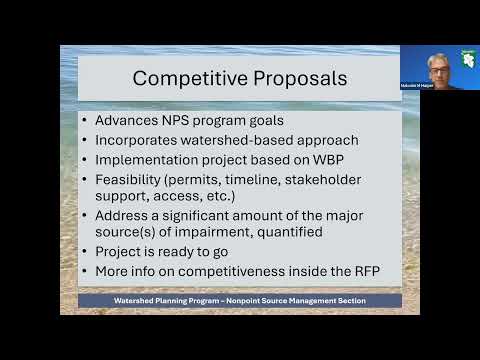
DEP: make proposals `watershed‑based,' feasible and quantifiable to be competitive
Summary
DEP staff advised applicants to adopt watershed approaches, show project feasibility and timelines, demonstrate stakeholder support, and report pollutant reductions in absolute units (pounds, tons) rather than percentages.
The Massachusetts Department of Environmental Protection urged applicants to frame proposals with watershed context, solid feasibility and clear, unit‑based pollutant reductions. The presenter said reviewers should be able to understand projects without prior familiarity and that feasibility—permitting, timelines and maintenance arrangements—will factor heavily in competitiveness.
“Please tell us how many tons of sand or how many pounds of phosphorus,” the presenter said, instructing applicants not to report percentage removals. The official also recommended including letters of support, describing who will maintain BMPs after construction and, where applicants lack in‑house technical capacity, naming contracted partners and their roles.
AI generated
The text on this page is AI generated. Summaries, highlights, analysis, and video transcripts are all produced from the original source material.
AI can make mistakes, so if you spot one, and we will fix it for everyone.
Note: the source content is unaltered by us. Any content source we link to, be it a video, an audio recording, or a document, is presented exactly as its publisher released it. That publisher is usually a government body, sometimes an individual official or another organisation.