Get Full Government Meeting Transcripts, Videos, & Alerts Forever!
Get email alerts on the Rps And Funding topic
No spam. Unsubscribe anytime.
MassDEP outlines 2026 watershed planning RFPs, highlights larger 604(b) pot and match waiver
Summary
MassDEP staff previewed the 2026 Request for Proposals for Section 604(b) planning and Section 319 implementation grants, describing eligibility, a larger-than-usual 604(b) budget (about $1.8M), and a temporary waiver of the 319 nonfederal match requirement for this cycle.
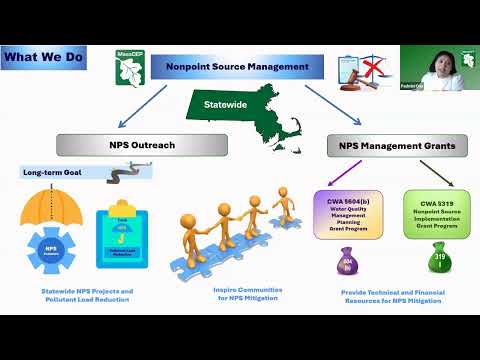
Massachusetts Department of Environmental Protection staff opened an RFP briefing with a program overview and details applicants will need to prepare proposals for Section 604(b) planning and Section 319 implementation funding. Richard Carey, director of the Watershed Planning Program, described the program as statewide and data‑centric with five technical sections and said the meeting would focus on the nonpoint source management section.
Panmini, a presenter with MassDEP's Watershed Planning Program, said this cycle’s 604(b) funding is "much bigger than our normal" due to base EPA funds plus Infrastructure Investment and Jobs Act (IIJA) support and estimated about $1,800,000 would be available for 604(b) planning awards. She also told applicants that, for 319 implementation funding, the allocation this round is "close to $2,500,000." Panmini announced the program will waive the usual 40% nonfederal match requirement at the state level for this funding cycle, but she cautioned that future waivers depend on funding availability and eligibility of projects to be used as match.
The briefing stressed program priorities and applicant responsibilities: 604(b) awards must have a governmental or quasi‑governmental lead grantee (municipalities, regional planning agencies, tribes, conservation districts, councils of government, counties or interstate agencies), while 319 implementation may be led by a broader range of public or private organizations. Panmini said projects must report pollutant reduction loads to EPA and that implementation projects must be tied to a MassDEP‑approved nine‑element watershed‑based plan or obtain plan approval before contract completion.
MassDEP encouraged applicants to use the department’s online supplemental materials and tools, including the INSPIRE capacity‑building resource and an eligibility form that carries selection points. The agency emphasized active, two‑way community engagement as a competitive priority and urged applicants to check Buy America (BABA) requirements and waivers for equipment and materials.