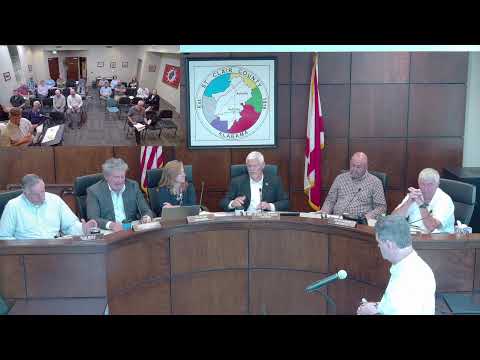
St. Clair County deliberates minimum lot sizes in proposed subdivision rules
Summary
At a county commission work session, commissioners, municipal officials and residents debated a draft requiring an average lot size of 11,500 sq ft (minimum 8,000) versus calls for a 15,000‑sq‑ft minimum, with participants citing traffic, school capacity and fiscal impacts.
The St. Clair County Commission spent the bulk of a work session debating proposed minimum lot sizes in a new draft subdivision ordinance, with staff proposing an average lot size of 11,500 square feet and a floor of 8,000 square feet per lot.
"Came up with an average of 11,500 square feet, for each, basically, sector of a subdivision," Dan Dahlke said as he reviewed the draft's approach to density. Commissioners and local officials pressed staff for the analytic basis of the figure; staff said traffic considerations were the primary driver and acknowledged they had not convened all utility providers to test capacity countywide.
Municipal leaders and residents warned of short‑term strains on schools, public safety and local infrastructure if density rises rapidly. One attendee described a recent development that produced "a close to 30% increase" in local school enrollment and urged the commission to weigh those consequences. The chair noted that while state funding can follow students, local governments often face immediate service demands.
Supporters of higher minimums framed them as consumer protection—citing past subdivisions with substandard roads or failing private sewer systems—while developers cautioned that overly strict countywide minimums would shift building activity to neighboring counties. Commissioners agreed to seek additional legal and technical review and to return with more detail, including invitations to affected municipalities and utility providers.
The commission did not vote on the draft; members said they will collect more data and hold further public meetings before advancing any formal ordinance.
AI generated
The text on this page is AI generated. Summaries, highlights, analysis, and video transcripts are all produced from the original source material.
AI can make mistakes, so if you spot one, and we will fix it for everyone.
Note: the source content is unaltered by us. Any content source we link to, be it a video, an audio recording, or a document, is presented exactly as its publisher released it. That publisher is usually a government body, sometimes an individual official or another organisation.