Get Full Government Meeting Transcripts, Videos, & Alerts Forever!
Get email alerts on the Eui Targets topic
No spam. Unsubscribe anytime.
Committee reviews EUI spreadsheet and BPS calculator; 2050 scenario shows roughly one-third median reduction
Summary
Technical committee members reviewed a spreadsheet scenario and a BPS calculator cross-checked with ASHRAE benchmarks; one scenario produced an approximate 30–34% median EUI reduction by 2050. Members asked staff for an updated calculator and clearer counts of buildings above target.
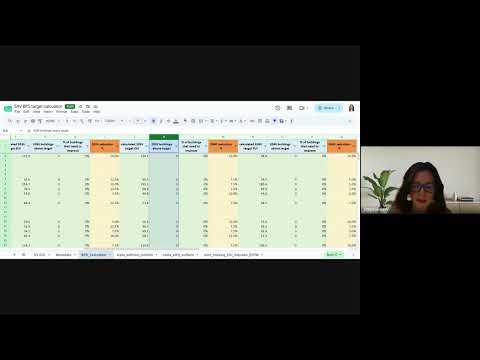
The Evanston technical committee reviewed a spreadsheet scenario developed by Stephanie that applied staggered building energy use intensity (EUI) reductions through interim milestones and produced a roughly 30–34% median EUI reduction by 2050 under one set of assumptions.
"So when we go all the way across, 2050 would yield a 34% total EUI reduction," Stephanie said while walking members through the BPS calculator and ASHRAE comparisons. Members pressed staff on how the spreadsheet calculates how many buildings are "above target," noting several columns showed zeros when members expected nonzero counts. Gabriela, who demonstrated Portfolio Manager and the BPS export, said Slipstream will supply an updated calculator that includes medians and counts by climate zone and building type so the committee can compare Evanston data with climate-zone statistics.
Committee members discussed whether ASHRAE (based on 2012 CBECS data) is the best benchmark or whether Portfolio Manager's zone-specific medians offer a better reference. The group agreed staff will circulate the updated calculator in Excel and guidance on using the file—members cautioned against opening the sheet in Google Sheets because translation may break formulas. The committee asked staff to prepare three baseline options (Evanston median, climate-zone median, and best-25% target) for comparison at the next meeting.