Get Full Government Meeting Transcripts, Videos, & Alerts Forever!
Get email alerts on the Water And Sewer Rates topic
No spam. Unsubscribe anytime.
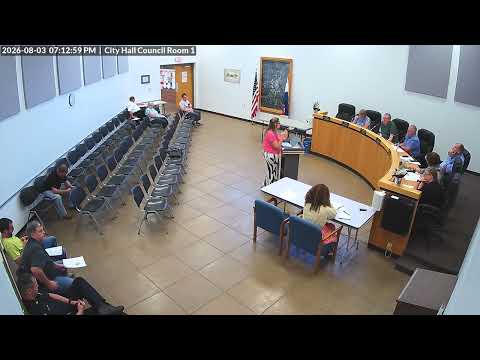
St. Clair board directs staff to pursue Jan. 1, 2027 water and sewer rate changes after consultant study
Summary
After a Missouri Rural Water consultant told the board the utility is operating in the red, St. Clair officials directed staff to prepare ordinances for a package that would adopt a larger immediate water increase and a modest sewer tier increase aimed at bringing the system to fiscal break‑even by late decade.
The St. Clair Board of Aldermen instructed staff to draft ordinances to implement new water and sewer rates aimed at restoring the utilities to fiscal balance, following a presentation by a Missouri Rural Water consultant and city administrators.
Valerie Mayne, a Missouri Rural Water consultant, told the board she analyzes the cost to produce and treat 1,000 gallons and recommended the study’s purpose was “to get out of the hole” and to ensure rates at least “break even.” She presented several structures: one raising the minimum bill to $19.97 with a $5.67 per‑1,000‑gallon charge, another keeping the minimum and raising large‑user per‑thousand rates to $6.77, and a third recommending a $14.55 minimum with a flat $7.25 per‑1,000‑gallon water rate.
Administrator Wilkins summarized staff analysis and recommended adopting water Option 3 (minimum $14.55 and $7.25 per 1,000 gallons) and sewer Option 2 (leave the minimum at $12.60 and raise tiered sewer rates to $6.77 per 1,000). Wilkins estimated the combined package would raise the utility bill for a 5,000‑gallon user by roughly $13–$20 per month and said the changes were intended to move the utility into the black over a multiyear timeline.
Board members questioned distributional effects on industrial accounts, asked whether developers could cost‑share for expansion, and debated whether to phase increases or apply a single larger increase. Multiple members favored a single immediate increase—the approach Wilkins described as “rip the Band Aid off”—to avoid repeated annual rises. The board directed Wilkins to research ordinance language (noting that some tiering may be spelled out in existing ordinance) and return with a draft for a late August or early September meeting with an aim of an effective date of January 1, 2027.
Mayne noted a potential procedural complication for sewer rates, telling the board that “the way the state statute’s written on sewer to have a public hearing is a little bit iffy,” and offered to return to answer public questions if the board wanted a dedicated public hearing; she added the city attorney may have a different reading.
Next steps: staff will review ordinance language affected by tiering, prepare cleaned‑up charts, and bring an ordinance back at the next meeting cycle for formal consideration.