Get Full Government Meeting Transcripts, Videos, & Alerts Forever!
Get email alerts on the County Budget topic
No spam. Unsubscribe anytime.
Pine County presents proposed 2026 budget, preliminary levy up 2.6%
Summary
County staff outlined a proposed 2026 budget that raises the preliminary property tax levy 2.6% and increases total county expenditures from about $53 million to $60 million, with the final levy scheduled for adoption Dec. 16.
Pine County officials presented the proposed 2026 budget to the public at a Truth in Taxation hearing, saying the county’s preliminary property tax levy is up 2.6% from 2025 and that the final budget and levy will be considered at the Dec. 16 board meeting. Kelly, a county staff member presenting the budget, said, “Our preliminary property tax levy was a 2.6% increase from 2025.”
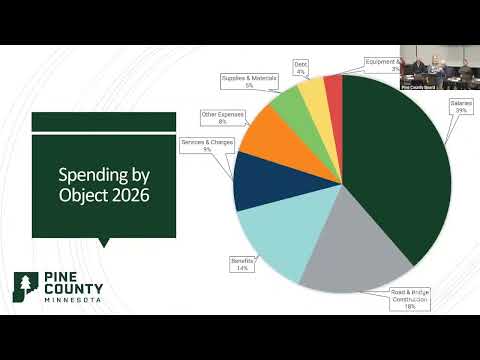
County staff framed the increase largely as a function of spending changes across several funds rather than an across‑the‑board tax hike. Total county expenditures were shown rising from about $53,000,000 in 2025 to about $60,000,000 in 2026 — a roughly $7.1 million increase — with much of that tied to project spending in the highway fund. The county reported a projected general fund shortfall of about $517,000 for 2026 before planned uses of reserves, and staff said about $350,000 of reserves and an ARPA transfer of roughly $536,000 are included in budget plans to reduce that gap.
The presentation broke the budget into multiple levy‑supported funds: general operations (courthouse, health and human services, road and bridge), three debt funds set by bond documents (jail, courthouse, a 2017 CIP bond), a technology fund, and a newly structured annual election levy planned at about $25,000 to smooth election-year spikes. Kelly noted that some funds, such as opioid‑settlement dollars and COVID‑19/ARPA funds, are restricted for specific uses and must be spent by set deadlines.
The board will consider and may adopt the final levy at its Dec. 16 meeting; staff encouraged members of the public with parcel‑specific valuation questions to consult the assessor’s office, which remained available after the hearing.