Get Full Government Meeting Transcripts, Videos, & Alerts Forever!
Get email alerts on the K16 Collaborative topic
No spam. Unsubscribe anytime.
Central Coast K‑16 collaborative brings $9.8 million to region, outlines $1M teacher tuition program
Summary
Director John Leopold told the Monterey County Board that the Central Coast K‑16 collaborative allocated $9.8 million in 2024 across six counties, including about $1.38 million to programs in Monterey County. The collaborative will fund dual enrollment expansion and pay most tuition for ~50 teachers to get single‑subject master’s degrees in English or math.
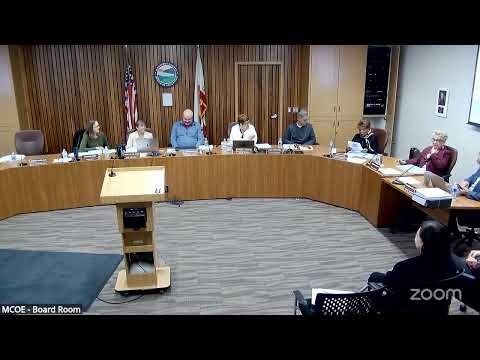
John Leopold, director of the Central Coast K‑16 regional collaborative, told the Monterey County Board of Education that the collaborative has focused on equity and labor‑market alignment since its 2024 funding year. "In 2024... we allocated $9,800,000, to school districts, community college, and 4 year universities along the Central Coast," Leopold said, adding that about $1.38 million went to Monterey County to expand career pathways in engineering, computer science and health care.
Leopold described an approach that pairs K‑12 schools, community colleges and four‑year institutions with industry partners so students can earn college credit and move directly into local jobs. The collaborative has supported paid work‑based learning and increased dual enrollment; "through our work, we've also funded... paid work‑based learning opportunities or internships," he said, noting more than $170,000 funded for Monterey County students this year.
A central next step is a teacher training effort aimed at sustaining dual enrollment expansion. "We're gonna be launching an effort next year to spend 1000000 dollars on helping high school teachers get their single subject master's degree in English and math," Leopold said, describing a plan to subsidize roughly 75% of tuition and train about 50 teachers through an online program at CSU Channel Islands. Leopold and board members said the program is intended to increase districts’ capacity to offer college‑credit courses locally and create clearer pathways to living‑wage jobs in the region.
Board members asked how allocations were determined; Leopold said the collaborative used an equity‑driven, noncompetitive formula weighted by CALPADS indicators (free/reduced price meals, homelessness, foster youth) and required partnership with community colleges and four‑year institutions. The presentation also noted work to expand counseling and family outreach so students and families understand available pathways.
The board praised the collaborative’s emphasis on equity and hands‑on career pathways and encouraged staff to keep working with local programs (for example, Monterey County initiatives and Hartnell College) to scale opportunities for students.