Get Full Government Meeting Transcripts, Videos, & Alerts Forever!
Get email alerts on the Budget topic
No spam. Unsubscribe anytime.
Kearney city administrator outlines $31.9 million proposed FY2026 budget
Summary
City Administrator Sheila presented a proposed fiscal year 2026 budget that estimates $31.9 million in non‑debt, non‑transfer revenues, highlights large capital investments in streets and water, and notes $1.4 million in projected reserves and several unfunded departmental requests.
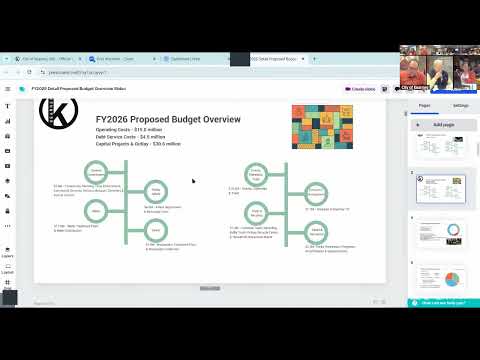
Sheila, the city administrator, presented an in‑depth, page‑by‑page review of the proposed fiscal year 2026 budget, saying, “This proposed budget includes $31.9 million of revenue.” The plan shows $43.5 million in total inflows when transfers and anticipated debt proceeds are included, with the largest recurring revenue categories being charges for services ($10.1 million), federal grants ($8.4 million), and sales taxes ($6.2 million). She told the board the city expects to use interfund transfers and some debt proceeds to fund capital projects.
The proposed expenditures include roughly $15 million in operating costs, about $4.5 million in principal and interest on existing debt, and $30.6 million in capital projects or one‑time outlays. Sheila emphasized conservative assumptions and pointed out the general fund operating revenues of about $8.9 million versus operating expenditures near $8.6 million, leaving a small operating margin that depends on using a portion of fund balance. She said the projected reserve at year end is about $1.4 million (roughly two months of operating expenses) and urged regular monthly financial reporting so the council can track results. The presentation also enumerated $3.6 million of unfulfilled non‑personnel requests and about $1.3 million of unfilled personnel requests the administration could not fund in the proposal.
The administrator walked the board through fund‑level details — from the general fund and municipal court to water and sewer funds — and highlighted major capital programs such as street preservation, a bridge replacement program, and ongoing parks and pathways work. The board asked follow‑up questions on fund balances, grant matches and timing, debt schedules, and several fee line items that staff said they would research further.