Get Full Government Meeting Transcripts, Videos, & Alerts Forever!
Get email alerts on the Code Enforcement topic
No spam. Unsubscribe anytime.
Tequesta proposes chronic‑nuisance property code with abatement agreements, magistrate process
Summary
Community development proposed a chronic nuisance ordinance defining threshold triggers (3 events in 30 days; 7 in six months) and a process for abatement agreements, one‑year monitoring, special magistrate hearings and possible cost billing to owners; council favored sending the draft to PZB and returning in September.
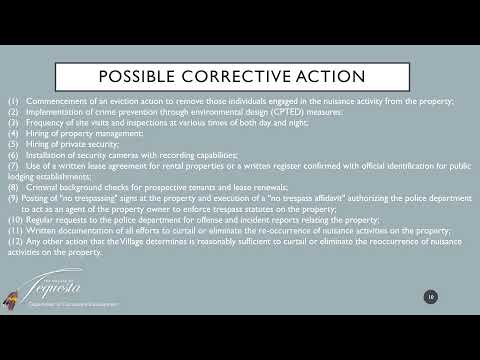
Community development director Jay Hopsch presented a draft chronic nuisance property code designed to give the village tools to address properties that generate repeated criminal activity, nuisance conditions or excessive public‑safety responses. The proposal was modeled on codes adopted in other municipalities and lays out qualifying nuisance activities, thresholds, corrective actions and enforcement steps.
Hopsch explained that a property could be declared chronic if it meets defined thresholds — for example, "a property becomes a nuisance when it is responded to 3 or more nuisance activities at a property within 30 days, 7 or more activities within 6 months, or 3 within 30 days or 7 within 6 months for an overdose," he said — and that the village manager would make a declaration after staff (police, code enforcement, building) build the case. The process would require a certified notice, creation of a nuisance abatement agreement with specific corrective actions, a 15‑day period to enter the agreement, and a one‑year monitoring period. If the owner refuses to comply, the matter could be prosecuted before a special magistrate, who could order corrective steps, authorize the village to provide chronic nuisance services and bill the owner for that cost; either side could appeal the magistrate's decision to circuit court.
Council members asked about how ownership transfers affect the pattern (staff said the pattern attaches to the property and the code can be clarified to address edge cases), due‑process protections, financial feasibility for required corrective measures (the magistrate can consider the owner's ability to pay), and the use of liens (staff said non‑homesteaded properties can be liened and the magistrate imposition process would be refined in the ordinance). Council supported moving the draft ordinance to the planning and zoning board (PZB) and returning a final ordinance for council consideration, likely in September.