Get Full Government Meeting Transcripts, Videos, & Alerts Forever!
Get email alerts on the Parole Eligibility topic
No spam. Unsubscribe anytime.
Committee weighs making DOC administrative findings trigger parole ineligibility after ACC escapes and assaults
Summary
The committee considered a draft that would place administrative disciplinary convictions for escapes or assaults on the same footing as court convictions for parole ineligibility; Board of Parole and DOC testified for codification, while public commenters warned about giving agencies de facto permanent sentencing power without court review.
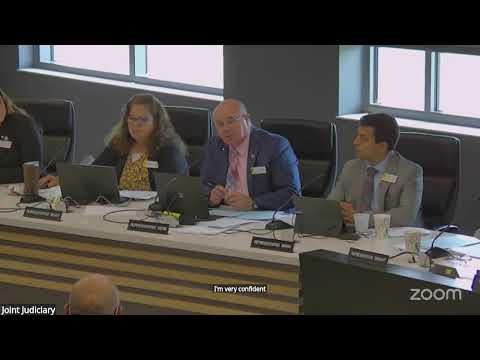
The Joint Judiciary Committee turned to parole‑eligibility changes aimed at escapes from adult community correctional centers (ACCs) and serious assaults in correctional settings. LSO staff introduced draft 27LSO48 (parole eligibility determinations amendments), which would make persons convicted of escape, or found in an administrative disciplinary process to have escaped or committed an assault resulting in serious bodily injury, ineligible for parole. The staff said the bill would be effective 07/01/2027.
Margie White, executive director of the Board of Parole, testified that the board has long treated court convictions as conclusive but has used DOC administrative findings as a rebuttable presumption; she and board members recommended statute put administrative disciplinary convictions on equal footing with court convictions so parole determinations are consistent and codified. "If the DOC found someone guilty of an assault that caused serious bodily injury, that inmate will become parole ineligible," White said, describing the board's proposed language to capture both weapons‑based assaults and assaults that cause serious bodily injury.
Dan Chan of the Department of Corrections described the DOC's serious‑incident review process, case counts, and the separation between department investigations and board decisions. DOC said it does not seek to be "judge, jury and executioner" and stressed procedural safeguards including institutional review and an appeals process within DOC and to the parole board. The department provided recent numbers: 34 escapes since Jan. 1, 2024, and roughly a dozen inmates declared ineligible for parole in recent years.
Public commenters urged caution. Nate Sekinga warned that allowing an agency's internal finding to impose permanent parole ineligibility amounts to vesting lifelong sentencing power in an agency without court oversight. "A permanent parole bar is a life sentence in effect. It should rest on a conviction in a court of law," Sekinga told the committee. Other victims and advocates urged stronger consequences for escapes and assaults. The committee chose to carry the draft to its next meeting so staff can refine language on definitions (e.g., whether a "deadly weapon" should exclude the body) and on handling out‑of‑state incidents and temporary ineligibility windows.