Get Full Government Meeting Transcripts, Videos, & Alerts Forever!
Get email alerts on the Upepa topic
No spam. Unsubscribe anytime.
Wyoming committee advances uniform anti‑SLAPP draft, adds religious‑expression and appeal changes
Summary
The Joint Judiciary Committee reviewed a Uniform Public Expression Protection Act draft, adopted amendments including adding 'religious expression,' aligning an appeal window to 30 days, and excluding non‑First Amendment communications; members tabled further action to allow more review and public comment.
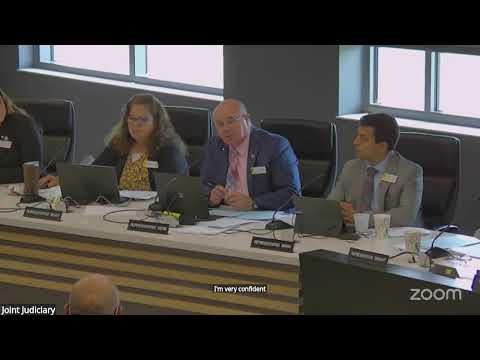
The Joint Judiciary Committee in Casper on the interim agenda reviewed a draft Uniform Public Expression Protection Act (UPEPA) intended to provide an expedited mechanism for dismissing lawsuits that target public participation. LSO staff walked the committee through the bill draft (27LSO00050 v0.5), which creates a new chapter in civil procedure, establishes a special motion to dismiss for suits implicating public participation, permits a stay of related proceedings, and includes a burden‑shifting framework and fee‑shifting provisions. "This bill draft would enact the uniform public expression protection act, which provides procedures for addressing and reviewing strategic lawsuits against public participation," LSO staff summarized during the presentation.
Committee members pressed staff on several drafting choices. Senators and representatives asked whether the draft's definition of "communication" could unintentionally protect perjury or other unprotected speech and whether the draft should explicitly limit the statute to speech that is "protected by the First Amendment or article 1, sections 20 and 21 of the Wyoming constitution." LSO staff recommended adding an exclusion for communications that are not constitutionally protected. A committee member noted an alignment issue: the uniform act sets a 21‑day appeal period while Wyoming appellate procedure allows 30 days; the committee voted to change the draft's appeal filing deadline to 30 days to match existing state practice.
Outside presenters pushed for different amendments. Scott Meyer of the Uniform Law Commission urged adopting the uniform act's structure but acknowledged parsing the definition of "communication" is complicated; Parker Jackson of the Goldwater Institute recommended language to make the statute substantive and proposed an immunity provision modeled on Pennsylvania's draft; Ben Scheffner of the Motion Picture Association and other witnesses argued fee‑shifting should remain mandatory to preserve deterrence. "I do like the idea of just the prevailing party," one committee member said during debate on fees, while Scheffner argued that mandatory fees help deter meritless suits.
Following public testimony and discussion, the committee adopted several changes to the draft: extending the appeal filing period from 21 to 30 days; adding "or religious expression" after the phrase "matter of public concern" to mirror Tennessee's approach; inserting a paragraph excluding communications not protected by the First Amendment (to address concerns such as perjury); and adding the adverb "substantively" to clarify the statute's substantive effect. Lawmakers rejected a separate motion to add a standalone immunity provision after members expressed concern about taking the draft further from the well‑tested uniform language. The committee ultimately voted to table additional action and carry the draft to its next meeting so staff can incorporate amendments and stakeholders can review changes. "Let's bring it back at our next meeting in an updated version, with the amendments built into it," one co‑chair said.