Get Full Government Meeting Transcripts, Videos, & Alerts Forever!
Get email alerts on the Federal Programs topic
No spam. Unsubscribe anytime.
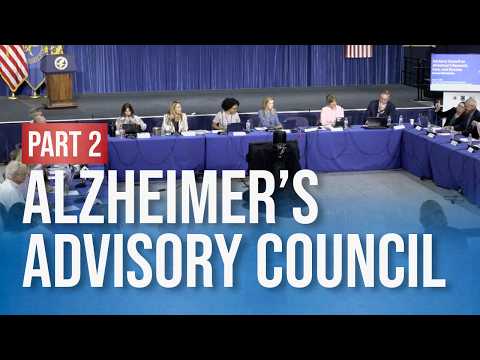
Federal agencies report new dementia initiatives: CDC, FEMA, HRSA, IHS and ASPE updates
Summary
Representatives from CDC, FEMA, HRSA, IHS and ASPE reported new cooperative agreements, a FEMA Alzheimer's task force, grants and training programs, and data collection plans (BRFSS modules) tied to dementia infrastructure and workforce development.
Multiple federal agencies gave short updates on programs to strengthen dementia care, surveillance and workforce capacity. Maria (ASPE) noted the national plan update process, five July listening sessions and an open RFI to inform milestones. Captain Lustilo (CDC) highlighted a cooperative agreement across 43 recipients, a learning action institute in Atlanta, the recent NOFO that drew 28 applications and plans to award at least seven recipients, and BRFSS module work for cognitive decline data in 2026 and 2027.
Michael Butovich (FEMA) announced a new FEMA Alzheimer's task force focused on preparedness, training and inclusion of people with dementia across mitigation, response and recovery. Dr. Joan Wise (HRSA) described geriatrics workforce programs using the 4Ms, supplemental funding to support training about limbic‑predominant pathology, and near‑term award actions to add more model‑of‑care grantees. Julie Crowder (Indian Health Service) said IHS serves almost 3,000,000 American Indian and Alaska Native people, described the CARES NOFO (open through September), tribal epidemiology center grants and an internal 4Ms‑based quality dashboard. "We formed a new FEMA Alzheimer's task force, which we're really excited about," one agency speaker said, describing its cross‑cutting composition.
Why it matters: the updates show coordinated federal activity across public health surveillance, emergency preparedness, workforce training, tribal health investment and evidence‑generation pipelines—an infrastructure effort intended to support both research translation and community care.