Get Full Government Meeting Transcripts, Videos, & Alerts Forever!
Get email alerts on the Housing Supportive Yellen Pines topic
No spam. Unsubscribe anytime.
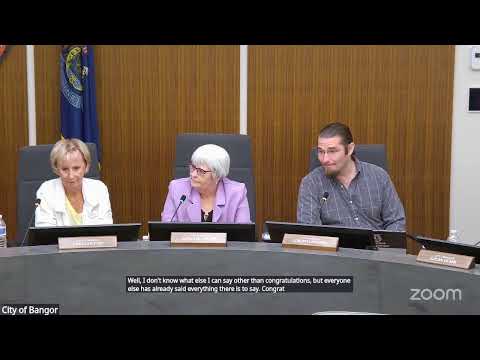
Bangor council approves TIF support for 30‑unit 'Home for Good' supportive‑housing project after heated public comment
Summary
After hours of public testimony both for and against, the council approved a credit‑enhancement agreement and a tax‑increment financing district to support a 30‑unit supportive‑housing project at 205 Corporate Drive (Yellen Pines/Home for Good), with conditions added to the agreement.
The Bangor City Council voted to approve city support for a 30‑unit supportive‑housing project at 205 Corporate Drive, often referred to in testimony as Yellen Pines or Home for Good, adopting an amended credit‑enhancement agreement and authorizing a TIF district for the site.
Opponents warned about long‑term fiscal risk and public‑safety concerns during two public hearings. Mike Burrow, a Bangor homeowner, told the council: "I want to talk about the 30 efficiency apartments, Yellen Pines, that I'm totally against," and listed alleged past property damage and a project cost he described as "$11,000,000 on the 30 efficiency apartments." Several speakers urged the council to delay and provide a complete 30‑year financial analysis before committing 75% of incremental taxes for three decades.
Supporters, including service‑provider representatives, emphasized the role of wraparound services. Jennifer Lollar, a hub coordinator in homeless services, said the homeless‑response data show long durations of homelessness and that "supportive housing is so important" because housing alone often isn't enough. Chris Saunders, vice president of operations at Preble Street, cited Portland's Logan Place results and told the council the model produced declines in jail nights and emergency‑service use, saying a TIF would be a "highly cost effective" way to fund the project without additional direct city operating support.
Councilors debated several outstanding questions — who would be served, whether services are guaranteed for the full 30 years, and how the project would affect municipal services and future tax revenue. A motion to amend the original order by substitution was offered to authorize the city manager to "execute and place conditions upon a credit enhancement agreement." The amended order was then moved for final passage; the meeting transcript records the amended order as having passed after roll‑call votes recorded in the session.
The council also opened and closed the public hearings for two related orders (the credit‑enhancement agreement and the TIF district) during the same meeting and heard repeated calls from residents for more fiscal detail. Proponents said the project cannot proceed without the TIF; opponents warned the city would be locked in if state funding streams change.
The council’s action allows the city manager, under the amended authorization, to finalize a credit‑enhancement agreement with conditions. The project’s sponsors said the TIF is necessary to make the development feasible and that the on‑site supportive services would be provided by established local nonprofits.