Get Full Government Meeting Transcripts, Videos, & Alerts Forever!
Get email alerts on the Cdbg Cooperation Agreement topic
No spam. Unsubscribe anytime.
Staff tells urban-county board HUD requalification requires perpetual restrictions on CDBG-funded property use
Summary
Board staff said a new HUD legal interpretation means municipal contributions to CDBG-funded properties must remain for CDBG-eligible uses in perpetuity or be repaid to the CDBG program; staff said they will not retroactively change past projects but will record covenants going forward.
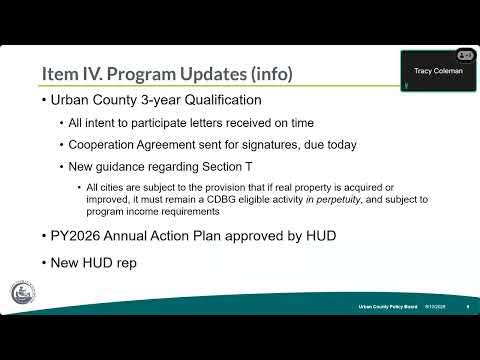
Rebecca Royce, staff to the Urban County Policy Board, told members the county submitted its three-year urban-county requalification package to HUD on Aug. 10 and outlined a change in how cooperation agreements will be handled.
"When the county puts CDBG funds into a property, either in acquisition or any improvements, it has to remain a CDBG eligible activity in perpetuity," Royce said, noting HUD's legal staff provided the interpretation. She said cities that participate in the interlocal agreement are treated as part of the county for this requirement and that proceeds from any sale of a property must return to the CDBG program if the use ceases to be CDBG-eligible.
The staff presentation used the Washougal community center as an example of a past project where officials had applied a five-year requirement; staff said the current HUD interpretation indicates those city contributions should have been restricted in perpetuity. Royce said staff will not revisit past projects to change recorded requirements but will implement permanent covenants and liens on future projects and will work with jurisdictions through application and project setup to ensure compliance.
Board members pressed staff for operational details. Tracy Coleman, La Center's community planning and public-works director, asked whether a repayment would equal the CDBG amount or include interest or property value; Royce replied repayment would be limited to the amount of CDBG funds invested. Royce also said program income generated by a property (for example, fees charged for facility rentals) will have portions that must be returned to the CDBG program or reinvested for eligible uses, and staff used a 10% program-income example to illustrate the mechanics.
Staff described the change as a current HUD legal interpretation subject to monitoring and possible future revision. Michael Torres, program manager at community services, said the interpretation is the present guidance from HUD but might evolve. Royce said the county had gathered all required letters and its legal opinion and submitted the HUD package on the due date; HUD will have roughly 30 days to review and notify staff if anything is missing or requires correction.