Get Full Government Meeting Transcripts, Videos, & Alerts Forever!
Get email alerts on the Land Use Traffic topic
No spam. Unsubscribe anytime.
Planning commission seeks faster fixes to Article 9, urges more traffic-impact studies
Summary
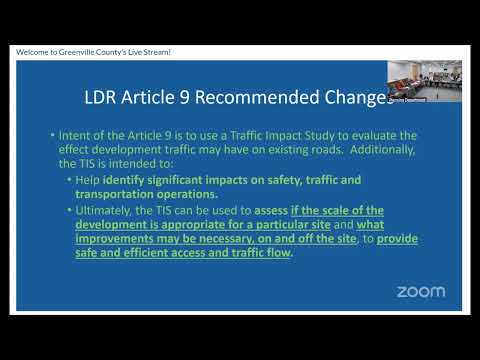
Greenville County planning commissioners presented draft updates to Article 9 of the land development regulations to require more traffic-impact studies (TIS) and clearer mitigation rules. Staff said the changes aim for near-term ("80%") improvements and will include approved-but-not-built projects in analyses.
Greenville County’s joint planning commission and council workshop on Article 9 centered on tightening when traffic-impact studies are required and what mitigation developers must carry out. Chair (S1) opened the session and staff presenters outlined that current county and state guidance leave wide flexibility for engineers and developers, and that county rules need clearer, enforceable thresholds.
Presenter (S3) said the changes are intended to give the county “better tools in the toolbox” to judge whether a subdivision or group development is appropriate given existing and approved-but-not-built infrastructure. He noted that in a small sample of recent subdivisions only about “Only 6% got TIS,” and proposed using capacity, level-of-service and pavement-quality metrics tied to road types so the county can decide whether a development may proceed or must mitigate traffic impacts.
Why it matters: commissioners and staff said accelerating a first round of edits will help avoid new subdivisions being approved on roads already at or near failing levels of service, and will make mitigation expectations clearer to developers and the public. Staff (S2) urged an iterative approach: “Let's get 80, 80, 90% improvement soon, quick, instead of trying to eat the entire elephant at once.”
The draft approach will be reviewed with county staff, refined to distinguish suburban and rural contexts, and returned to the planning commission and council for further guidance. The presenters repeatedly emphasized that the planning commission's role is recommendatory and that council must ultimately approve any LDR changes.