Get Full Government Meeting Transcripts, Videos, & Alerts Forever!
Get email alerts on the Project Overview topic
No spam. Unsubscribe anytime.
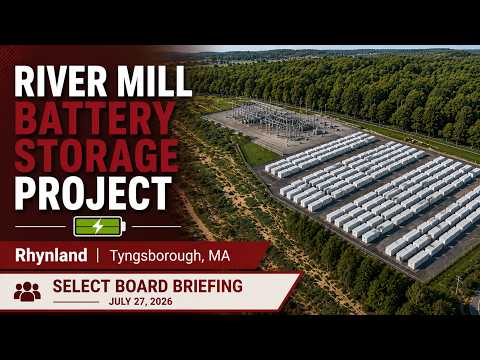
Developer outlines 500 MW River Mill battery storage project for 406 Middlesex Road in Tyngsborough
Summary
Rhineland Energy presented a 500 MW / 2,000 MWh battery energy storage system planned for 406 Middlesex Road, saying the project was selected in Massachusetts' first storage solicitation and aims to store excess renewable energy for dispatch during peak periods; the presentation was informational and no local approval was required.
Rhineland Energy told the Tyngsborough Select Board it plans a 500‑megawatt, 2,000 megawatt‑hour battery energy storage project at 406 Middlesex Road, a site the company said sits adjacent to a high‑capacity transmission corridor and already has conservation‑level stormwater and tree‑clearing permits. "It's a 2,000 megawatt hour project," said Brian Benito, vice president of development at Rhineland. "Essentially that means that this project will be able to discharge 500 megawatts continuously for 4 straight hours."
Benito said the project was one of four awarded in Massachusetts' first solicitation for storage to help the commonwealth meet a 5,000 MW storage goal by 2030, and described the facility as unmanned in regular operations, with most traffic limited to construction and periodic maintenance. He said the company is pursuing MassDOT review of a curb cut and has designed on‑site stormwater retention. Town staff told the board the use is permitted "by right" under local industrial zoning and that prior permitting steps included conservation commission approvals for tree clearing and stormwater.
Why it matters: developer officials framed the project as a tool to help integrate intermittent renewables by storing excess generation and dispatching it at evening peaks. The developer said the project will interconnect to the regional grid (ISO‑NE) and that utility procurement credits (clean peak energy credits) and displacement of older peaker plants provide system‑level benefits over time. The presentation was informational only; no Select Board approval was required at the meeting.