Get Full Government Meeting Transcripts, Videos, & Alerts Forever!
Get email alerts on the Algae Study topic
No spam. Unsubscribe anytime.
Research team proposes nearshore algal study for Lake George, estimates $55,000 for 100-site assessment
Summary
A Freshwater Institute researcher outlined a two-tier plan to measure nearshore benthic algae at 100 point sites using a BenthoTorch and targeted bay video surveys; the preliminary cost estimate for the point assessment is about $55,000, with an additional $30,000 margin for a broader bay-wide survey.
Jeremy Farrell, co-principal investigator with the Freshwater Institute, proposed a two-part study to better understand nearshore algal communities in Lake George and to move “from anecdotal to scientific observations” about algal growth in areas where people swim and recreate. Farrell told the commission the primary approach would be a 100-site point assessment using a BenthoTorch to measure chlorophyll per unit area on rocks and site-specific scrapings to identify algal taxa.
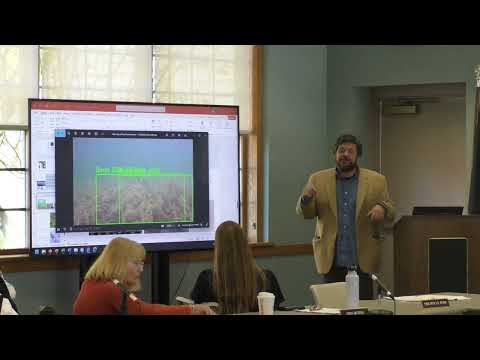
Farrell described complementary data streams: in situ sondes at sample locations, laboratory nutrient analyses, and (if purchased) a FlowCam device to accelerate microscopic counts. “It is, go to 100 places across the lake, assess the algal community,” he said, summarizing the point-assessment plan. Farrell also previewed a more experimental bay-wide video approach using underwater imagery and image-recognition models to map macrophytes and filamentous algae across transects.
On cost, Farrell gave approximate figures: about $55,000 for the 100-site point assessment and an additional roughly $30,000 if the group expanded to a bay-scale video assessment to fill spatial gaps. He said sample processing and laboratory nutrient work are the expensive elements and estimated the team could produce results by the following winter after samples are processed and analyses completed. Commissioners asked whether species lists would indicate nutrient sources; Farrell said diatom- and species-based indices, combined with environmental variables, could suggest disturbance linking but would not always identify a single causal source.
The commission did not vote on funding; Farrell asked for feedback to refine a formal proposal. Next steps discussed included defining sampling polygons, specifying bays for targeted video transects (for example, Sawmill Bay and Basin Bay), and returning with a costed, detailed proposal for commission review.