Get Full Government Meeting Transcripts, Videos, & Alerts Forever!
Get email alerts on the Flock Lpr topic
No spam. Unsubscribe anytime.
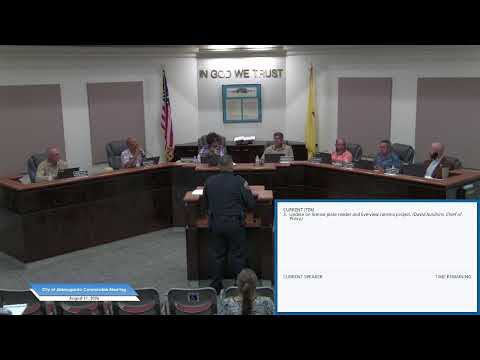
Alamogordo police demonstrate Flock license-plate reader; officials stress investigatory limits
Summary
City officials received a demonstration of the Flock LPR platform, which department staff say provides fixed, point-in-time license-plate reads and supports 'hot list' alerts but does not continuously track people or supply registration/owner data.
Alamogordo police staff presented the Flock license-plate reader system and described it as an investigatory tool that supplies fixed, point-in-time reads to help identify a vehicle’s location. The presenter told commissioners the system supports partial-plate searches and a 'hot list' that alerts the department when a vehicle of interest passes a camera, but stressed it "does not continuously track anybody."
The presenter described what a read shows — a close-up of a license plate, the date and time it was captured and the specific location where the camera is mounted — and emphasized what it does not show: the identity of drivers, registration and insurance details, immigration status or continuous movement between camera points. He said the department retains live-view footage for seven days and can download and save footage if it is needed for an investigation.
Officials walked commissioners through examples where the platform reportedly shortened investigations: a reported stolen vehicle was located on a tow truck after a read, avoiding escalation with outside jurisdictions; in an alleged assault, a read provided a breadcrumb that, combined with witness statements and other investigative work, led to an arrest within about 30 minutes. The department also reported an increase in solvability for hit-and-run crashes of "76%" since using camera data.
The presenter framed the system as a tool that supplements police work rather than replacing personnel: "an officer costs us about $94,000 a year with salaries and benefits," he said, and the LPR provides value by pointing investigators toward relevant footage or vehicle locations. The department said accounts are restricted: an internal administrator must create user accounts and the platform includes automated flags and human audits to detect potential misuse.