Get Full Government Meeting Transcripts, Videos, & Alerts Forever!
Get email alerts on the Judicial Transparency topic
No spam. Unsubscribe anytime.
Wyoming judges, clerks and municipal leaders split over online posting of court records in House Bill 93 debate
Summary
The House Judiciary Committee heard extensive testimony on House Bill 93, which would require free online access to court records and audio/video; judges and clerks warned of privacy, redaction and cost burdens while advocates urged greater transparency. The committee declined to sponsor HB93 for 2027.
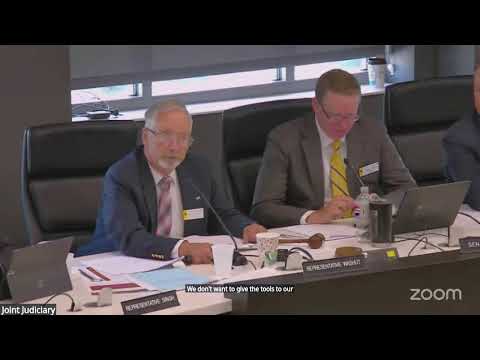
The Wyoming House Judiciary Committee spent more than two hours on House Bill 93, titled "the people's right to judicial transparency," an LSO-drafted proposal to make court records and hearing audio/video available online at no cost.
LSO staff described the draft as broad: "This bill would have required court records and audio recordings or or video of court proceedings to be publicly available online at no cost," said Mister Fuller, who walked the committee through the bill's definitions, exemptions, a judicial-systems automation account funding change and a $100,000 general‑fund appropriation for implementation.
Why it matters: proponents say searchable, internet-accessible court records would make the justice system more accessible to citizens, reporters and small-government watchdogs; opponents say the bill as drafted would create privacy and security problems, large new recurring staffing and technology costs for courts and local governments, and practical risks to juror sequestration, victim privacy and ongoing investigations.
Judges and clerks who spoke to the committee said the idea of remote public access is laudable but the draft is too expansive without clearer safeguards. "Generally, we would not support this bill for a variety of reasons," Carbon County District Court Judge Donessa Snyder told members, pointing to juvenile, adoption and other confidential statutes and the operational burden of redactions. Snyder and other judges described problems courts that have required streaming have faced, including people hacking feeds and disturbing content: "They then began displaying really problematic material to the point that 1 of the participants requested the court provide counseling services," she said.
Court administration said the branch is exploring options and vendor responses to a request-for-information, but stressed substantial work remains. State Court Administrator Alisa Butler told the committee the branch anticipates one to three years and additional funding to reach remote public access safely while keeping confidential records protected: "To get to remote public access, there is quite a bit of policy work that needs to be done ... and that is a big if because right now, we do not have adequate funding to allow for remote public access."
Municipal leaders warned the bill shifts long-term costs to towns. Ray Pacheco, mayor of Casper, said his municipal court handles more than 12,000 filings a year and estimated that implementing online posting and redaction could require at least one additional full‑time employee for a recurring annual cost he put at roughly $60,000–$120,000, not including storage, cybersecurity and indexing.
Advocates urged the committee not to delay. Parker Jackson, a Goldwater Institute staff attorney, called Wyoming "one of the least accessible and least transparent judicial branches of any state in the country" and urged lawmakers to adopt a framework that can be refined, arguing that filers already bear initial redaction responsibility under existing e‑filing rules.
Committee action: after public comment and debate, the committee took up amendments and votes and ultimately did not sponsor House Bill 93 for the 2027 session. Members cited unresolved questions about redaction safeguards, costs for municipal courts, the logistics of archiving searchable audio/video, and risks of automated scraping and monetization of court content.
What happens next: the Judiciary Committee asked LSO and the judicial branch for more detailed fiscal estimates, a tighter set of statutory exemptions, and technical options for separating the public-facing database from confidential underlying case-management systems. The bill may be reconsidered in a future meeting once those items are clarified.