Get Full Government Meeting Transcripts, Videos, & Alerts Forever!
Get email alerts on the County Planning topic
No spam. Unsubscribe anytime.
Warren County planner outlines $3M in grants, septic repairs and lake-protection work
Summary
Warren County principal planner David Nelson told the Lake George Park Commission the county secured more than $3 million in grants in 2025 and is pursuing septic replacements, culvert assessments and a 'thriving hamlets' housing initiative tied to the county's Warren County 2040 plan.
David Nelson, principal planner with Warren County, told the Lake George Park Commission on Feb. 24 that the county is translating its Warren County 2040 comprehensive plan into grant-funded projects and technical assistance for municipalities.
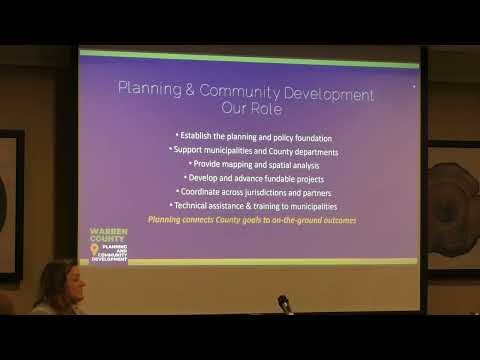
"We had more than 3,000,000 dollars awarded in 2025," Nelson said, citing dozens of projects in infrastructure, housing, water quality and recreation. He described the county's role as advisory and technical — providing GIS mapping, spatial analysis and grant-writing support to small towns and departments across the county.
Nelson summarized several active efforts: a septic-system replacement program (a 2024 award of roughly $400,000 that led to 16 failing systems replaced or repaired in 2025), a "thriving hamlets" grant-funded initiative to analyze buildable capacity in hamlet areas, a railway-feasibility inventory for almost 40 miles of county-owned rail along the Hudson, and a countywide culvert assessment funded through a Climate Smart Communities grant. He emphasized outdoor recreation as an economic driver — "about 33% of our economy" — and said the planning work aims to balance economic vitality with environmental quality in the Lake George region.
Commissioners asked technical questions about culvert assessments and program sustainability. Nelson said culvert work evaluates structural condition and functional sizing with an eye toward accommodating current peak-storm events and prioritizing replacements. On future septic funding he said amounts will vary but that demonstrated success in the program should make similar funding more available. "If showing success in this program will open the doors for us to get similar amounts," he said.
Why it matters: the county's grants and technical assistance fund work that directly affects lake health — septic compliance, stormwater and culvert upgrades, and shoreline projects — and help small municipalities implement planning and zoning changes that could reduce development pressure on sensitive shoreline. Nelson invited commission members to trainings and noted the county's role as an implementation partner rather than a regulator.