Get Full Government Meeting Transcripts, Videos, & Alerts Forever!
Get email alerts on the Nuclear Waste Management topic
No spam. Unsubscribe anytime.
Savannah River scientist outlines AI-driven SCOPE project to aid legacy waste processing
Summary
Tom Danielson, a scientist at the Savannah River National Laboratory, described SCOPE — the Salt Chemistry Optimization and Prediction Engine — saying the project will apply artificial intelligence to guide blending and processing of legacy radioactive tank waste to improve safety and reduce taxpayer costs.
Tom Danielson, a scientist at the Savannah River National Laboratory, told listeners the SCOPE project is part of the Genesis mission and aims to use data and modeling to support waste processors. "I'm a scientist at the Savannah River National Laboratory in the Environmental and Legacy Management Directorate," he said, introducing himself and his role in the effort.
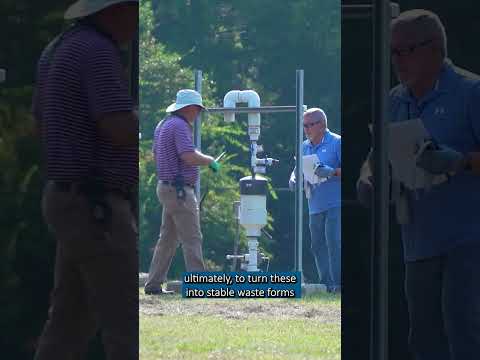
Danielson defined SCOPE as the Salt Chemistry Optimization and Prediction Engine and said its purpose is to "help to inform, scientists and engineers, the people who are processing some of the most challenging waste" that the U.S. government retains from Manhattan Project and Cold War–era activities. He said the project will examine detailed chemistry and apply artificial intelligence to guide how operators blend and run material through complex waste-treatment facilities, with the objective of producing stable waste forms that pose minimal environmental risk.
"As part of this, we're going to be using AI not only to make better decisions, not only to improve safety, but also to save taxpayer dollars on 1 of the nation's largest financial liabilities in waste processing," Danielson said. He framed SCOPE as a technical support and decision-aid effort rather than a regulatory action, describing it as intended to inform scientists and engineers working in processing operations.
The presentation did not specify funding amounts, timelines, or which treatment facilities would adopt SCOPE's outputs. Danielson did not list formal actions, votes, or regulatory changes tied to the project during the remarks; he described SCOPE as a research and engineering support activity within SRNL's Genesis mission and emphasized its technical goals.