Get Full Government Meeting Transcripts, Videos, & Alerts Forever!
Get email alerts on the Flood Mitigation topic
No spam. Unsubscribe anytime.
Preferred Cross Creek alternative favors deeper channel; council cautions on private‑property impacts and maintenance costs
Summary
A consultant presented three Cross Creek (Mill Creek) flood-mitigation alternatives and said the preferred option is a deeper, larger channel (Option 3). Council raised concerns about private-property easements, Army Corps and FEMA permitting, long-term maintenance, and an approximate cost estimate of $7.8 million; staff will move the project into the design phase for further evaluation and funding.
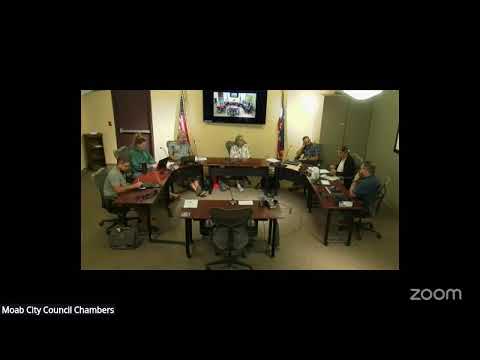
Consultant Mark presented the draft Cross Creek (Mill Creek) flood‑mitigation study to the Moab City Council on Aug. 11, outlining three alternatives and a recommended preferred plan.
Mark explained the study scope — modeling hydraulics between Main Street and 500 West and evaluating 10/50/100‑year flow scenarios — and said the team developed three alternatives: a levee-with-trail (not recommended), a hybrid levee-plus‑channel increase, and a preferred large, deeper channel. "Number 3 is our preferred alternative. That is simply a much larger, deeper channel," he said.
Councilors pressed on private‑property impacts. The consultant acknowledged substantial easement or fee‑simple acquisition needs in several pinch points and said some trail alignments would require crossing private property. He also noted that the project would likely trigger Army Corps and FEMA permitting and mitigation obligations in wetland and habitat areas.
Cost considerations were discussed in general terms. The consultant described a multi‑treatment project with a high excavation component; council members and staff referenced a planning‑level estimate near $7.8 million for major construction, while acknowledging costs will vary by chosen alignment and mitigation scope.
Councilors emphasized preserving the area’s ‘wild’ character where possible, minimizing trail impacts on private property and balancing flood mitigation with landscape and habitat considerations. Staff said next steps include finalizing the report, resolving property conflicts, pursuing design contracts and seeking grant or bond funding; staff indicated a positive direction to proceed into the design phase and noted there will be additional stakeholder engagement.
No formal approval to construct was taken; council gave direction to move from study to design and to continue coordination with property owners, regulators and potential funders.