Get Full Government Meeting Transcripts, Videos, & Alerts Forever!
Get email alerts on the Hardship Application topic
No spam. Unsubscribe anytime.
Landmarks hearing: West Park Presbyterian seeks hardship demolition; applicant and opponents sharply divided
Summary
At a packed LPC hearing, West Park’s owners and consultants argued the 134-year-old church is structurally and financially unsalvageable and meets the narrow nonprofit "hardship" test; preservationists, elected officials and arts groups countered with independent studies, fundraising offers and transfer‑of‑development‑rights proposals.
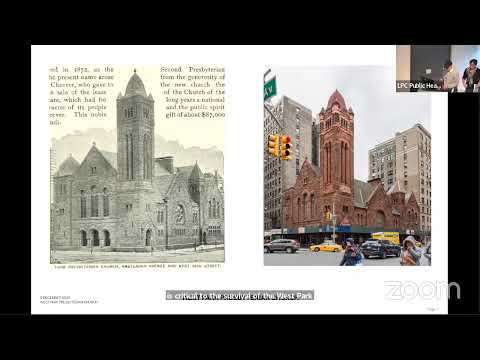
The Landmarks Preservation Commission heard a contested hardship application on Dec. 9, 2025, from West Park Presbyterian Church’s owners seeking permission to demolish the 134‑year‑old landmark at 165 West 86th Street and replace it with a new mixed‑use building and a 10,000‑square‑foot community facility.
Valerie Campbell, land‑use counsel for the applicant, framed the case as a rare statutory hardship under Administrative Code §25‑309: the owner must show the property cannot earn a “reasonable return” and is no longer suitable for its charitable purposes. "The applicant must also show that the property would not be capable of earning a reasonable return," Campbell told the commission during the presentation of the application. The applicant team presented engineering reports and cost estimates and said a sale to Alchemy Properties is contingent on demolition approval.
The owner’s witnesses described extensive masonry and structural problems. Rick Lafever of FacadeMD testified that on close inspection "large fragments separating from the wall confirmed the vertical orientation of bedded layers" and estimated more than half of the ornamental stone requires repair. Structural engineer Mohammed Rahal reported walls leaning up to 12 inches at the gable and recommended major stabilization, saying the roof truss creep results in an outward thrust on exterior walls.
On the financial question, Adam Wald, retained by the applicant, ran multiple reuse scenarios tied to a 2025 assessed value and concluded that "under all 4 scenarios, a reasonable return cannot be achieved." The applicant and its development partner say proceeds would endow a large West Park Social Justice Fund and fund a new worship space for the congregation.
Opponents — including preservation organizations, community groups and elected officials — presented contrary evidence. Rep. Nadler’s chief of staff Robert Gotheim read a statement urging the commission to reject the application and said independent structural reviews found the building could remain in charitable use. Council Member Gail Brewer and State Sen. Brad Hoylman Siegel urged denial, pointing to independent consultant reports and to fundraising and repair offers that, they said, were rebuffed by the presbytery.
Speakers for the Center at West Park and allied preservation engineers offered lower cost estimates to remove the long‑standing sidewalk shed and perform essential façade and roof stabilization. Michael Hiller, counsel to the center, said an old‑structures report placed immediate work at roughly $1,000,000 and argued the applicant’s claim of catastrophic deterioration was overstated.
The hearing drew more than 100 speakers both for and against the application, including many neighborhood residents and arts organizations. Testimony also touched on procedural matters such as monitoring reports the applicant performed in 2022–23, the presbytery’s prior actions toward tenants, and the marketing (or lack thereof) of transferable development rights.
The commission closed the public comment period at the meeting’s end to allow staff and consultants to analyze the record; the item will be returned to a public meeting in early 2026 for further consideration and possible preliminary determination.
The hearing record includes divergent technical and financial opinions; commissioners repeatedly questioned both sides about assumptions, alternative phased repair approaches, and whether the reported repair costs reflect replacement in kind or less expensive alternatives. The commission’s own consultants will continue reviewing submitted reports before the next public meeting.