Get Full Government Meeting Transcripts, Videos, & Alerts Forever!
Get email alerts on the Historic Preservation topic
No spam. Unsubscribe anytime.
Landmarks approves removal of curved display at Steinway reception room to restore 1925 sightlines
Summary
The Landmarks Preservation Commission voted 8–0 to allow Bonhams to remove a mid‑century curved shadow‑box from the Steinway & Sons reception room at 111 W. 57th St., restoring original bronze mullions and enlarging the vision glass by roughly 1 foot at the top and 18 inches at the bottom.
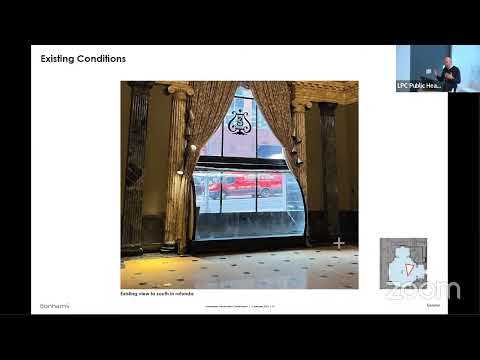
The Landmarks Preservation Commission on Jan. 6 approved an application by Bonhams to remove a curved display "shadow box" installed behind the exterior storefront glazing of the Steinway & Sons reception room at 111 West 57th Street. The commission voted 8–0 after staff and the applicant said the feature is a mid‑century alteration that now impedes views into the designated interior.
Cass Stackelberg, the applicant's representative, said the removal is intended to restore the reception room’s original visibility and public access. "I will be able to stand at this window and look in as it was in 1925, and I will also be able to walk in and go into the space and enjoy the space," she told commissioners. Presentation materials and staff reports showed the curved glass was likely installed after the building's construction and that glass in the shadow box was replaced in the 1990s.
Opponents argued the curved glazing is a rare example of an early storefront invention and should be preserved. John Graham of the Victorian Society in New York said the window is a patented, historic show window and asked the commission not to permit its removal. In response, the applicant and staff said the current configuration has been altered over time and that removing the later addition would restore the 1925 condition while retaining and repairing the original bronze mullion system.
Commissioner Chen read the motion finding the shadow box a later‑added feature whose removal would better restore the interior landmark; the motion was seconded and passed unanimously. The commission record notes that the vision glass area will be expanded by about one foot at the top and 18 inches at the bottom and that bronze framing will be retained, cleaned, and repaired.
The decision follows review of the building’s designation materials, historic photographs, and the applicant’s drawings. The commission did not specify a final disposition for the removed curved glazing in public testimony; the applicant said that issue has not yet been discussed.