Get Full Government Meeting Transcripts, Videos, & Alerts Forever!
Get email alerts on the Animal Health topic
No spam. Unsubscribe anytime.
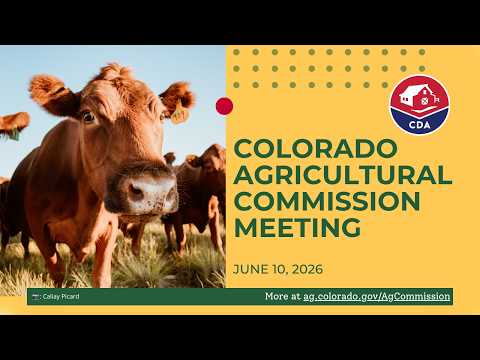
Colorado Agricultural Commission adopts emergency rules to limit animal movement after screwworm detections
Summary
The commission voted to adopt emergency revisions to livestock disease-control rules after recent U.S. detections of New World screwworm, imposing CVI, permit and inspection requirements for animals from affected zones and emphasizing that food safety is unaffected.
The Colorado Agricultural Commission voted June 10 to adopt emergency revisions to the state—s livestock disease-control rules in response to recent U.S. detections of New World screwworm.
The motion to adopt the emergency revisions was made by Commissioner Colleen Peppler and seconded by Vice Chair Jeff McCullough; the chair announced the motion carried by voice vote and the rule was adopted. Dr. Maggie Baldwin, who presented the rule and the outbreak context to the commission, said "So, overall, we've had 6 detections in The United States," and emphasized that "food supply is safe." The adopted emergency measures follow the USDA continuity-of-business guidance and aim to reduce the risk of introducing and establishing the pest in Colorado.
Under the emergency rule, any warm-blooded animal originating from a defined infested zone must meet enhanced requirements. Baldwin explained that animals from an infested zone must have a Certificate of Veterinary Inspection (CVI) issued within 5 days prior to movement and that Colorado will issue a permit within 48 hours prior to movement. Animals arriving from an infested zone must be inspected during offloading by a licensed and accredited veterinarian, a state or federal animal-health official, or another state-authorized inspector. Any animal found with myiasis (infestation by screwworm larvae) may not move; animals with open wounds must be treated prior to movement unless they are moving direct to slaughter and will be slaughtered within 72 hours.
The commission emphasized the rule is iterative and subject to revision as more information becomes available from Texas and USDA surveillance. The commission noted coordination with partner states and federal agencies is ongoing; Baldwin said Colorado's immediate focus is preparedness, communications with producers and veterinarians, and implementing the inspection and permit processes described in the emergency rule.
The commission adjourned at 11:05 a.m.; the next scheduled meeting is July 22 in Delta, Colorado.