Get Full Government Meeting Transcripts, Videos, & Alerts Forever!
Get email alerts on the Budget topic
No spam. Unsubscribe anytime.
Administration recommends 3.5% real-estate tax increase to close budget gap
Summary
District finance staff presented a five-year projection showing rising expenses that outpace projected revenues and recommended a 3.5% real-estate tax increase as the administration's preliminary proposal to narrow the 2026-27 shortfall; board members asked staff to run alternative percentages for the preliminary budget.
The Big Spring School District administration presented a multi-year budget projection and recommended a preliminary real-estate tax increase of 3.5% for 2026-27 to narrow a projected deficit. Mrs. Lentz, presenting the finance update, said the administration's recommended combination of revenue and expenditure assumptions "would generate about 1,100,000 in additional revenues."
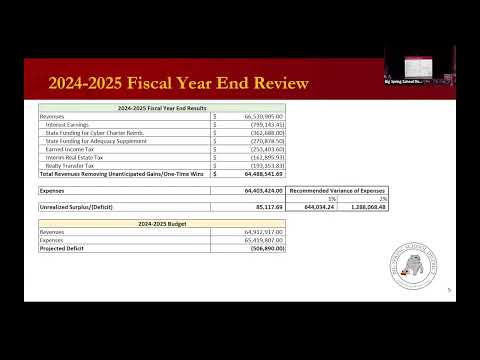
The presentation showed two revenue scenarios and assumed expense growth near current inflation (about 3.3%). Mrs. Lentz warned that while one-time windfalls and unusual receipts improved recent results, recurring revenue has been closer to the district's baseline: "If we take out all those one-time gains ... our revenues would have been more like 64,400,000," she said, describing an $85,000 recurring surplus in the most recent audited year after removing nonrecurring items. The administration also quantified taxpayer impact: under the recommended 3.5% change, the median homeowner's annual bill would rise by roughly $103.67 in a year.
Board members pressed staff on key assumptions including whether adequacy (state) funding and assessed-value growth were included. Mrs. Lentz confirmed adequacy money was folded into the 2026-27 estimate but cautioned it is not guaranteed beyond that year. Superintendent (speaker 4) framed the choices as a trade-off of values and long-term risk: "The decision this year will definitely impact next year," he said, warning the board may face larger structural deficits if revenue growth does not keep pace with expenses.
The board requested staff to prepare a set of alternative percentage scenarios (including intermediate percentages such as 1.85% and 2.25%) for the preliminary budget adoption scheduled at the next meeting. No formal tax rate was adopted in this session; the administration will present a proposed preliminary budget to the board in May and a final adoption is planned in early June after a 30-day public display period.