Get email alerts on the Accessory Dwelling topic
No spam. Unsubscribe anytime.
Council denies accessory‑dwelling request for mobile trailer as ADA accommodation
Summary
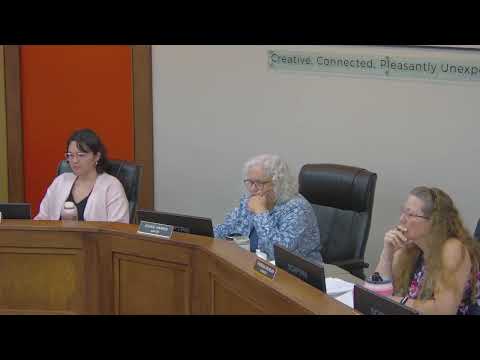
After a lengthy hearing, council voted 4–0 to deny a conditional‑use request allowing a permanently sited trailer/RV as an accessory dwelling, citing unresolved sewer and utility hookup questions and neighborhood compatibility; the applicant, Kimberly Raider, said the trailer was the quickest option to meet mobility needs.
The council heard an emotional appeal from applicant Kimberly Raider, who requested a conditional use to place a trailer/RV on her R‑1 lot as a short‑term reasonable accommodation for mobility limitations. The applicant told the council this option had to be fast and removable: "This is the quickest way, safest way, and the best way for me to get what I'm looking for, for me to get safe in in my own on our own property," she said during the hearing.
Council, planning staff and the zoning administrator pressed on utilities and code compliance. Members raised concerns that the trailer solution did not clearly meet local ADU and sewer‑connection rules; one council member said the primary reason for denying the request was unresolved utilities and compatibility with the existing home. After deliberation, Councilmember Brewer moved to override the planning commission recommendation and deny CU‑2026‑01; the motion passed 4–0.
Council members suggested alternatives that would meet zoning and utility requirements, including a garage conversion or a permanent accessory structure hooked to house utilities. Staff and the applicant were directed to consider those options and return with feasible, code‑compliant plans. The council emphasized it was seeking solutions that balance reasonable accommodation with existing zoning and public‑health standards.
AI generated
The text on this page is AI generated. Summaries, highlights, analysis, and video transcripts are all produced from the original source material.
AI can make mistakes, so if you spot one, and we will fix it for everyone.
Note: the source content is unaltered by us. Any content source we link to, be it a video, an audio recording, or a document, is presented exactly as its publisher released it. That publisher is usually a government body, sometimes an individual official or another organisation.