Get Full Government Meeting Transcripts, Videos, & Alerts Forever!
Get email alerts on the Budget topic
No spam. Unsubscribe anytime.
Big Spring SD finance committee recommends 3.5% tax increase as five‑year projection shows mounting deficit
Summary
The district’s finance presentation recommended a preliminary 3.5% real‑estate tax increase for the 2026–27 budget and warned that conservative revenue growth and rising expenses could create structural deficits within five years.
The Big Spring School District finance committee on April 20 heard a budget update that included an administration recommendation to propose a 3.5% increase in the real‑estate millage for the 2026–27 preliminary budget. Mrs. Lent, the district finance presenter, told the board the administration would bring a proposed budget for adoption on May 4, beginning the statutorily required 30‑day advertisement period before final action in June.
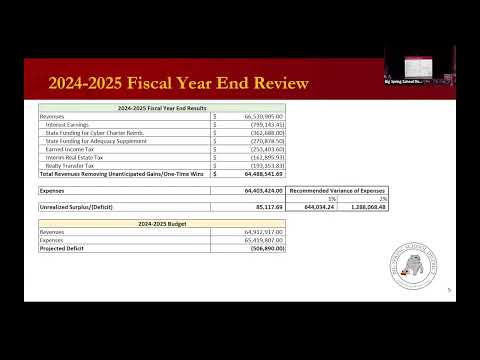
The presentation reviewed fiscal 2024–25 audited results (revenues just over $66.5 million), one‑time gains that masked recurring revenue, and a narrow recurring surplus of roughly $85,000 after removing non‑recurring items. The administration modeled two five‑year scenarios and said that, under modest revenue growth and an assumed 3.3% annual inflation in expenses, the district could face a multi‑million‑dollar shortfall by 2027–28. “If we look at 2728 we have the potential to sit in this auditorium next year…and I don't want it to be a surprise but we could sit in here with a $2 million need and a $1.3 million ability,” said Dr. Grante, the superintendent, emphasizing the compounding effect of recurrent shortfalls.
Board members asked staff to run additional millage scenarios; the administration provided examples: partial index adjustments (1.7% to 2.15%) would yield several hundred thousand dollars, while raising to the full Act 1 adjusted index (~4.3%) would produce about $1.37 million. Mrs. Lent cautioned that several variables remain uncertain — state funding, cyber‑charter student costs, fuel and medical trends — and noted the district has used one‑time windfalls in prior years to support capital needs. The committee directed administration to calculate alternate percentages requested by board members before the May preliminary adoption.
What happens next: the board plans to vote to adopt a proposed preliminary budget at its May 4 meeting; that proposal may be lowered but not raised before final adoption in June.