Get Full Government Meeting Transcripts, Videos, & Alerts Forever!
Get email alerts on the Transportation topic
No spam. Unsubscribe anytime.
Seaside SD upgrades buses with stop-arm cameras, new routing software to tackle safety and efficiency
Summary
Transportation Supervisor Chris Peters told the board the district has upgraded bus cameras and installed stop‑arm cameras on most route buses, rolled out advanced routing software (Traversa) and a parent app, and flagged enforcement and ROI questions for follow-up.
Seaside School District’s transportation supervisor outlined a series of investments the district says will improve safety and operational efficiency, from routing software to stop‑arm cameras on buses.
"One of the things I learned about myself this year is I actually like ride driving the school bus a lot better than I thought I would," Chris Peters told the board as he introduced the report, then listed districtwide metrics: "150,000 rides to school, 500 athletic trips, 200,000 miles driven, and over 20,000 gallons of fuel." Peters said staffing turnover required outside training support from neighboring districts and that the district upgraded its routing software to the advanced version of Tyler Technologies' Traversa to automate stop rules and improve route-building.
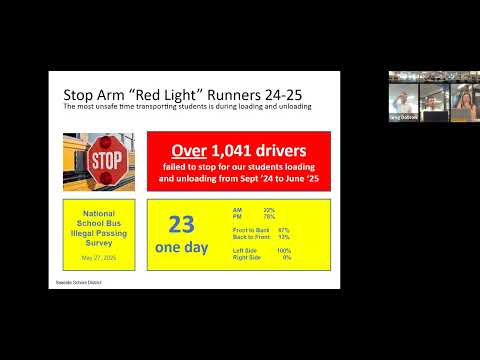
Peters also described new hardware: stop‑arm cameras have been installed on two‑thirds of buses and on all route buses, plus standardized interior and exterior camera layouts intended to capture license plates and driver perspectives. He said footage is recorded to drives and can be uploaded to the cloud with a wireless upgrade, and that the district has begun outreach to local law enforcement to determine citation processes.
Board members asked how video would be monitored, how often staff would report enforcement outcomes and whether the routing software’s cost savings could be translated into a clear return on investment. Peters said staff will work to associate miles and fuel consumption with dollars and report trend lines so the board can evaluate potential ROI and future resource requests.