Get email alerts on the Soil Testing topic
No spam. Unsubscribe anytime.
Presenter: standard soil testing needs 8–10 ft holes; existing building blocks testing
Summary
A presenter told the meeting that standard soil and infiltration testing requires digging multiple test holes 8–10 feet deep to document soil profiles and run infiltration tests, but said that cannot be done because a building now occupies the site; a participant warned permits "may not get approved."
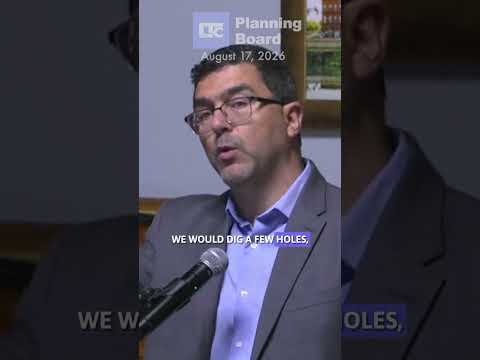
A presenter explained that standard subsurface investigation for a new development typically occurs in the design phase on a vacant parcel and requires digging multiple test holes to collect soil profiles and infiltration data. The presenter said the team would "dig a few holes uh 8 to 10 ft deep and then we would analyze the soils, we would document the soil profile, we would run infiltration testing in the hole that we dug." The description framed those steps as the basis for the technical data the project team had been asked to provide.
The presenter said that approach is not possible on the parcel under discussion because a building already occupies the site. "We can't do that because there's a building there now. I don't think it's appropriate to knock a chunk of the building down just to do a a few holes in the ground," the presenter said, identifying a logistical constraint that prevents the standard testing protocol. A meeting participant responded, "I hear what you're saying," and added that "not we may not get approved," flagging a concern that permitting or approval might be at risk given the inability to perform the usual tests.
No formal action or decision was recorded in the transcript about alternative investigation methods or next steps; the discussion identified the testing requirement (8–10 ft test holes and infiltration testing) and the present physical constraint (existing building) as the primary technical and procedural issues to resolve.
AI generated
The text on this page is AI generated. Summaries, highlights, analysis, and video transcripts are all produced from the original source material.
AI can make mistakes, so if you spot one, and we will fix it for everyone.
Note: the source content is unaltered by us. Any content source we link to, be it a video, an audio recording, or a document, is presented exactly as its publisher released it. That publisher is usually a government body, sometimes an individual official or another organisation.