How campuses should handle WorkKeys credit: simple workflows, who approves, and what to post
Summary
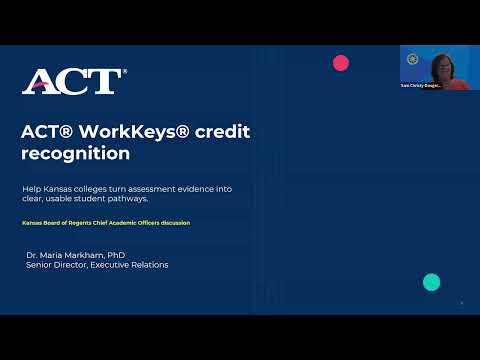
ACT's senior director and Board staff urged campuses to name decision roles (advisors, faculty, registrars), create plain-language guidance for students, and test small workflows so earned WorkKeys credentials translate into usable credit without harming transfer pathways.
Campus leaders were given practical steps to turn the Board's policy and state law into workable processes on individual campuses.
"Who reviews the request? Who approves the credit? Who posts it? Who explains it?" Dr. Maria Markham asked, urging institutions to name roles clearly so students and staff know the workflow for credit for prior learning. She recommended starting with likely use cases and a manageable pilot, documenting questions that arise, and building a feedback loop to refine the process.
Speakers emphasized plain-language communication so advisors can explain to students, and registrars can consistently record CPL on transcripts. Dr. Markham said institutions should avoid transcripting credit that will not serve a student's intended pathway — for example, awarding credit that appears to satisfy baccalaureate quantitative requirements when it will not transfer — because that can harm students' transfer prospects and Pell eligibility.
The presenters recommended institutions consider early candidate programs for rollout (technical certificates and programs most aligned with WorkKeys evidence), involve faculty and workforce partners in mapping, and publish course-equivalency information so students can determine how credentials will apply to degree progress.
AI generated
The text on this page is AI generated. Summaries, highlights, analysis, and video transcripts are all produced from the original source material.
AI can make mistakes, so if you spot one, and we will fix it for everyone.
Note: the source content is unaltered by us. Any content source we link to, be it a video, an audio recording, or a document, is presented exactly as its publisher released it. That publisher is usually a government body, sometimes an individual official or another organisation.