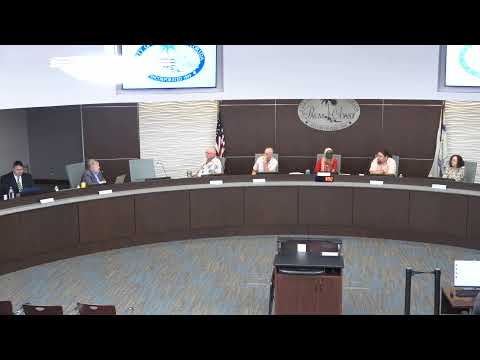
Planning board backs Land Development Code update, moves to tighten development extensions and to restrict data centers
Summary
The Palm Coast Planning and Land Development Regulation Board voted 4–0 to recommend City Council approve wide-ranging LDC updates that limit development‑order extensions, restrict zoning-change frequency and create a pathway to regulate data centers through special exception review and a later ordinance.
The Planning and Land Development Regulation Board on Aug. 19 recommended City Council adopt changes to the city’s Unified Land Development Code that would shorten the time development approvals can be extended, limit how often a property owner may petition for rezoning and create a new process to regulate data centers.
Jose Papa of the community development department told the board “the language will now go from... having to renew it every 12 months to renew it one one time for 24 months provided that that development has a valid certificate of concurrency.” The change follows City Council direction and aims to reduce the risk that older impact‑fee schedules remain locked in for years while projects sit dormant.
Why it matters: staff and council said the city’s prior approach — annual renewals with multiple extensions — could allow a development order to remain in effect long enough that developers pay impact fees set under an older schedule. Staff said state rules also limit how often impact fees can be updated, and the reform is intended to balance property‑owner rights with currency of city fees and regulations.
Key LDC changes the board recommended: limiting development‑order extensions to a single renewal of 24 months; permitting an applicant to seek a zoning change for the same property only once every 24 months; changing MPD bond language from “may” to “shall;” developing a follow‑up ordinance with penalties for unpermitted tree removal; and directing staff to produce a separate ordinance that defines and tiers data centers and sets performance standards.
On data centers, staff said the amendment would make those uses not‑permitted by right. If a data center is proposed, it would go through a special‑exception public hearing and — under the current proposal — require approval by a supermajority of City Council if the use is otherwise prohibited in the district. "If you want to do a data center, you're going to have to go through a public hearing process," Papa said, adding that staff expects to draft tiered performance standards in a later ordinance.
Public comment included neighbors urging stronger restrictions. "We need to just ban these things here in Palm Coast," said Janie Dwarte, a nearby resident, raising health and land‑use concerns about existing facilities.
What’s next: The board’s 4–0 recommendation sends the package to City Council for further review. Staff scheduled a Council wrap‑up workshop for Sept. 8, a first reading on Sept. 15 and a tentative adoption on Oct. 6.
The board’s recommendation is advisory; City Council will make the final decision.
AI generated
The text on this page is AI generated. Summaries, highlights, analysis, and video transcripts are all produced from the original source material.
AI can make mistakes, so if you spot one, and we will fix it for everyone.
Note: the source content is unaltered by us. Any content source we link to, be it a video, an audio recording, or a document, is presented exactly as its publisher released it. That publisher is usually a government body, sometimes an individual official or another organisation.