City staff propose streamlined neighborhood traffic‑calming process with lower petition threshold
Summary
Public works proposed lowering the initial petition threshold from 75% to 51%, adding geometry/operation pre‑screen filters and a 100‑point safety matrix (speed, pedestrian risk, volume, crash history) to prioritize neighborhood calming actions.
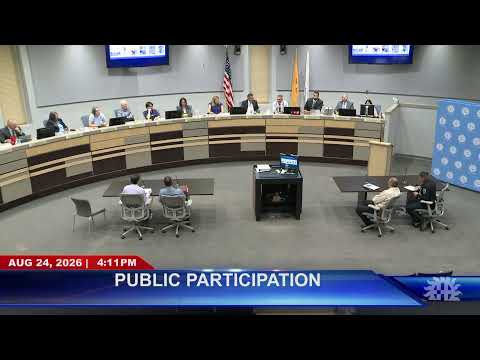
Jimmy Moreno, interim public works director, presented proposed revisions to the neighborhood traffic‑calming program that staff say will reduce delays and increase transparency. Moreno said the current process requires an initial petition at 75% and a later 51% ballot; staff propose prescreen geometry/operational filters and dropping the initial threshold to a simple majority (51%) so staff can move candidate streets into a data‑driven prioritization matrix more quickly. “We're dropping the threshold from 75% to 51%,” Moreno said.
Moreno described a 100‑point prioritization matrix to guide interventions: speed (40 points), pedestrian risk (30 points), traffic volume (20 points) and crash history (10 points). Streets scoring into Tier 1 would receive education and enforcement options; Tier 2 would get temporary mitigation and 12‑month evaluation before permanent work; Tier 3 would be fast‑tracked for permanent measures when funding allows. Staff said the city has about $500,000 from GRT set aside for temporary traffic devices and roughly $26,000 for permanent installation and traffic studies.
Councilors pressed staff on petition scope (homeowner vs. resident signatures), appeals for rejected petitions and how prior petition work would be handled; traffic staff said petitions use county records to identify owners and that staff can override the matrix in exceptional circumstances and would consider options to include renters or carry forward prior petition work.
Council members broadly supported streamlining but stressed equity concerns (counting renters) and requested more detail on outreach, petition collection and how pilot locations will be selected.
AI generated
The text on this page is AI generated. Summaries, highlights, analysis, and video transcripts are all produced from the original source material.
AI can make mistakes, so if you spot one, and we will fix it for everyone.
Note: the source content is unaltered by us. Any content source we link to, be it a video, an audio recording, or a document, is presented exactly as its publisher released it. That publisher is usually a government body, sometimes an individual official or another organisation.