Get email alerts on the Dog Beach topic
No spam. Unsubscribe anytime.
Committee tables Evanston dog‑beach ADA access contract amid cost and design concerns
Summary
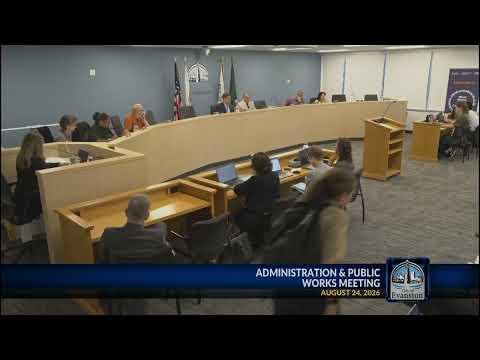
The Administration & Public Works Committee tabled a $773,850–$863,850 design‑build agreement for Evanston Dog Beach after public commenters and council members said the plan is over‑engineered and costly; staff warned four ADA grievances and potential Army Corps permits complicate cheaper alternatives.
Council members tabled consideration of a design‑build agreement for Evanston Dog Beach after weeks of public concern about scope, cost and accessibility.
The committee had before it resolution 191 r 26, an agreement with John Kano & Company Inc. for the Dog Beach ADA access build (RFP 2633). The staff‑presented bid options were $863,850 (option 1b) and $773,850 (option 1a); committee members and public commenters said those figures far exceed earlier estimates and neighborhood expectations. "This revised plan manages somehow to give the shorter project to the same construction company for nearly the same high price as the original longer project," said Jeff Berini, a 2nd Ward resident who urged a shorter ramp and a closer look at engineering choices.
Council members pressed staff on alternatives, permitting and how the price rose from a prior construction‑only estimate of about $694,000. Laura Biggs, the city engineer, explained that the earlier $693,000 figure represented construction only and that the new procurement is a design‑build RFP that includes roughly $83,500 in design fees: "The previous price that was around $693,000 was for construction only... the design fees are about $83,500." Biggs also told the committee that permanent ramp work in the beach zone may require an Army Corps of Engineers permit.
Several council members argued for lower‑cost temporary or simpler solutions. "We could have even had a temporary ramp up, an aluminum ramp... that would have cost us under $100,000," said Council member Kelly, who led the effort to delay the item and meet with staff about streamlined options. Supporters of a permanent design warned that temporary fixes may not meet ADA requirements or the unique needs of a dog beach where sand shifts and containment is required.
With multiple council members and public commenters urging more study and at least four ADA grievances reported to staff, Council member Kelly moved to table the item to the committee's second September meeting to allow staff conversations with council and potential community partners; the motion passed on a roll call and item A9 was tabled until the September meeting. The committee recorded that any final contract would likely require further environmental and permitting review before construction could proceed.
AI generated
The text on this page is AI generated. Summaries, highlights, analysis, and video transcripts are all produced from the original source material.
AI can make mistakes, so if you spot one, and we will fix it for everyone.
Note: the source content is unaltered by us. Any content source we link to, be it a video, an audio recording, or a document, is presented exactly as its publisher released it. That publisher is usually a government body, sometimes an individual official or another organisation.