Get email alerts on the Data Centers topic
No spam. Unsubscribe anytime.
Coffee County planning panel advances data‑center zoning amendments to full commission
Summary
The Planning Commission refined and approved sending zoning-language changes related to data centers — including a 500‑foot setback, noise limits, water‑use restrictions, generator enclosure requirements and host‑community provisions — to the full commission for a public hearing in October.
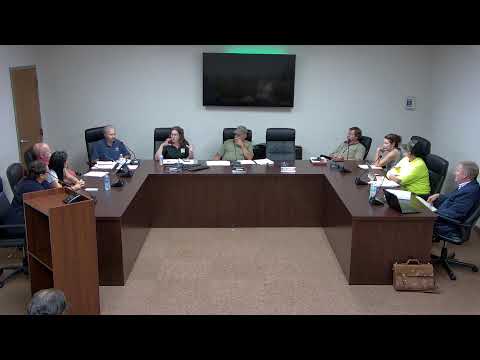
The Coffee County Planning Commission on Aug. 25 moved a package of zoning amendments related to data centers to the full County Commission for consideration and public hearing. Commissioners agreed to consolidate conflicting permitted‑use language in section 4.047, add a new C1‑R (residential) vs. C1‑C (commercial) distinction, and include data‑center‑specific standards for setbacks, noise, water use and emergency response.
Mayor (speaker 4) framed the initial problem, asking the commission to “delete paragraph 9 in its entirety and then relabel the following paragraphs” to remove contradictory permitted‑use listings. Staff member Mark (speaker 10) handed commissioners a redlined draft of the resolution and said he had included previous meeting comments: “I handed out to everybody just a red line copy from our last meeting with some of the comments and changes that were, that were made.” Commissioners discussed technical items — a proposed 500‑foot minimum setback from parcel lines, daytime/nighttime noise caps, quarterly sound monitoring, prohibition of direct connection to public water for cooling (with limited potable hookups allowed), and required host‑community mitigation such as training and equipment for first responders.
Technical specifics discussed for inclusion in the draft: a working setback of 500 feet from parcel lines (with the option to revisit if evidence warrants), daytime and night/weekend noise targets explicitly noted in the draft (67 dBA daytime, 57 dBA night/weekend), an as‑built noise study within six months of operation and periodic (quarterly) monitoring, a water‑feasibility study to show no adverse groundwater impacts if a facility proposes on‑site water systems, generator run‑time limits balanced against emergency needs (72‑hour fuel supply commonly discussed), and reclamation/liability language already in the county’s M2 provisions (existing liability and reclamation thresholds were reviewed and flagged for any needed tailoring to data‑center specifics). Dr. Keith Timel, a local resident and engineer who provided an informational primer, emphasized evolving cooling technology and the need for enforceable, measurable verification: “Data centers are evolving by the millisecond at this point,” he said, noting closed‑loop and non‑water cooling options are becoming more prevalent.
The commission voted to forward the revised resolution language with a positive recommendation to the full commission, with staff tasked to prepare a formal resolution for the Oct. 13 public meeting and to ensure required advertisement and a 15‑day notice period. Mark will draft the formal resolution and incorporate clarifications about temporary occupancy/inspection timing, sound‑study requirements and host‑community agreements before the next filing.
AI generated
The text on this page is AI generated. Summaries, highlights, analysis, and video transcripts are all produced from the original source material.
AI can make mistakes, so if you spot one, and we will fix it for everyone.
Note: the source content is unaltered by us. Any content source we link to, be it a video, an audio recording, or a document, is presented exactly as its publisher released it. That publisher is usually a government body, sometimes an individual official or another organisation.