Get email alerts on the Redevelopment Overview topic
No spam. Unsubscribe anytime.
Council workshop outlines redevelopment map, incentives and community engagement
Summary
City staff presented a connectivity and opportunity map and described tools — including TIFs, brownfield grants and PPPs with the University of Tennessee — intended to attract private investment and guide public infrastructure spending across multiple redevelopment areas.
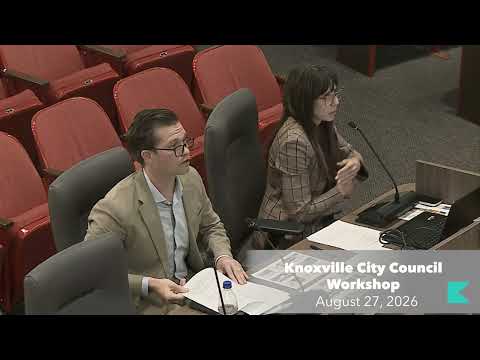
Council leaders and city planning staff held a workshop focused on city-owned and strategically important properties, presenting a new connectivity map meant to guide public investments that catalyze private redevelopment. Chair opened the meeting at 6:01 p.m. and asked staff to summarize priority sites and the tools available to support them.
Rebecca Jane Justice, an urban design and development team representative, said the mapping and toolset are intended to be a living resource and to align public investment with private development opportunities. "So we're hopeful that this is sequential and that it follows and reminds you have a reminder of that process as we go through each of these projects," she said. Staff said the map will be digitized in KGIS and linked on the city's website for ongoing updates.
The presenters highlighted a combination of incentives — tax increment financing, facade/historic preservation programs and brownfield grants — that have been used to stabilize sites and attract developers. Ben Benley, a presenter, cited a recent downtown redevelopment that used tax increment financing and a development agreement with KCDC to support mixed use and an estimated 50 condominiums. The workshop concluded with staff citing performance metrics since 2020: "We have driven over $2,000,000,000 in private investment, and I did say billion, creating and preserving, 8,000 housing units," Justice said.
Why it matters: staff framed the tools as a way to concentrate infrastructure spending around walkability, greenways and pedestrian connections while using private development to fund or justify new utilities, pedestrian bridges and streetscape improvements. Council members asked for clarity about when public previews of developer proposals will occur and how public engagement differs among city‑owned sites, redevelopment districts and privately held parcels.
AI generated
The text on this page is AI generated. Summaries, highlights, analysis, and video transcripts are all produced from the original source material.
AI can make mistakes, so if you spot one, and we will fix it for everyone.
Note: the source content is unaltered by us. Any content source we link to, be it a video, an audio recording, or a document, is presented exactly as its publisher released it. That publisher is usually a government body, sometimes an individual official or another organisation.