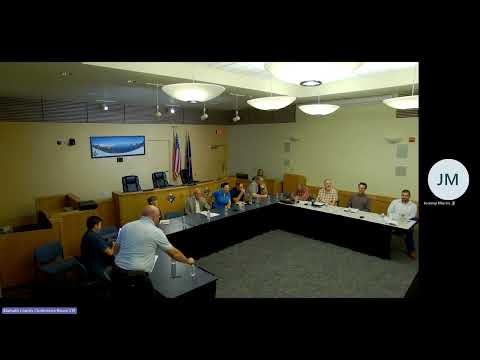
Planners flag water, SDCs and wildfire risk as constraints on densification
Summary
Commission discussion emphasized that water-main size, system development charges and wildfire risk shape where higher-density housing can go; staff said infrastructure requirements often mean developers must upgrade mains to create lots.
Multiple commissioners raised infrastructure and public-safety constraints on enabling denser development. One commissioner warned that small water mains and limited fire flows could make higher-density infill risky in wildfire-prone or poorly served neighborhoods, noting that sprinklers do not solve distribution or pressure shortfalls (SEG 631–637, SEG 1972–1996). A staff member explained county code requires existing infrastructure to support a proposed development or for the developer to pay for upgrades through SDCs and similar mechanisms (SEG 1943–1951).
Participants discussed policy options: restrict higher-density allowances to areas served by city-level water and sewer, create a 'sustainable housing' overlay that guarantees utilities before allowing reduced setbacks, or pursue state and federal funding to extend mains. A commissioner urged proactive planning to avoid ad hoc, uncoordinated infill that could further strain systems and complicate emergency response (SEG 1768–1787, SEG 1816–1830).
AI generated
The text on this page is AI generated. Summaries, highlights, analysis, and video transcripts are all produced from the original source material.
AI can make mistakes, so if you spot one, and we will fix it for everyone.
Note: the source content is unaltered by us. Any content source we link to, be it a video, an audio recording, or a document, is presented exactly as its publisher released it. That publisher is usually a government body, sometimes an individual official or another organisation.